
COD RTO Reduction Strategies: How Predictive Intelligence Reduces Ecommerce Losses
By the FastFlowPe Commerce Intelligence Team — reviewed August 2026
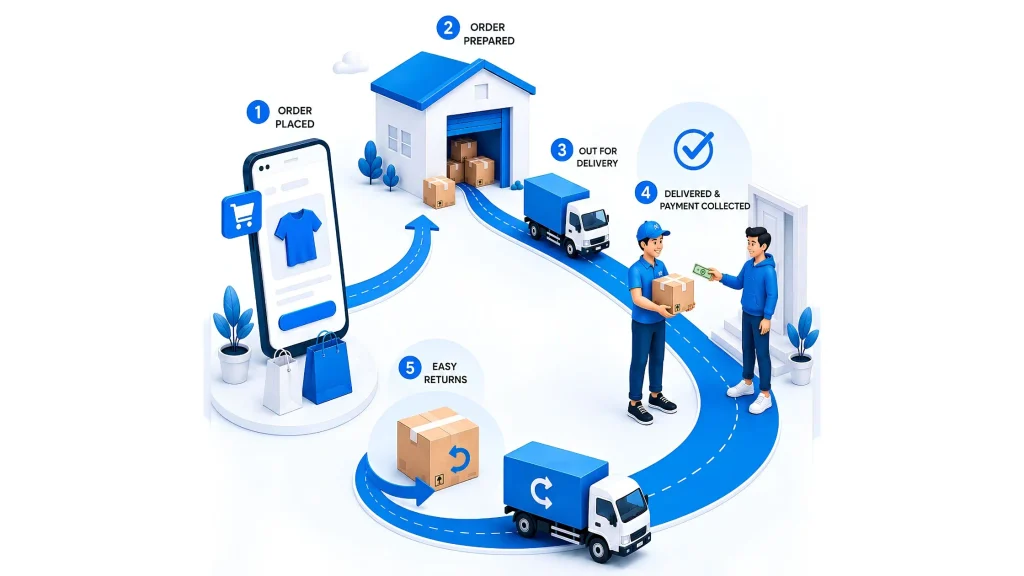
A customer places an order. The checkout looks successful, inventory gets allocated, and the package ships. Then the delivery call goes unanswered, the address turns out to be incomplete, or the customer simply changes their mind — and the shipment comes back. This is exactly the problem effective COD RTO reduction strategies are built to solve, and it’s becoming one of the most important operational disciplines in Indian ecommerce.
This is Return to Origin, or RTO — and effective COD RTO reduction strategies are quickly becoming one of the most important operational disciplines in Indian ecommerce. According to GoKwik’s analysis of over 180 million shoppers, India’s average RTO rate sits around 23%, while Pragma’s research puts COD-specific RTO between 20% and 40% depending on category. For fashion and footwear brands, that figure regularly touches 40%.
This guide walks through what actually drives RTO, what it costs, and how predictive intelligence helps merchants apply COD RTO reduction strategies without simply switching off cash on delivery.
What Is RTO in Ecommerce?
RTO occurs when a shipment cannot be delivered and returns to the seller. In a COD transaction, this typically happens because:
- The customer refuses delivery
- The customer is unreachable by phone
- The address is incomplete or inaccurate
- Purchase intent changes after the order is placed
- Multiple delivery attempts fail
A related term worth knowing is the Non-Delivery Report, or NDR — the warning stage before RTO. An NDR signals a failed delivery attempt; if it goes unresolved, it becomes an RTO. Consequently, acting on NDRs within hours rather than days is one of the highest-leverage moves a merchant can make.
Many merchants only look at RTO after it happens. However, that is already too late — by the time an order becomes RTO, the business has committed inventory, packaging, and shipping costs in both directions. The more useful question is whether the delivery risk could have been flagged before the order shipped.
The Scale of the Problem, in Numbers
Industry data on India’s RTO rate varies by source, category, and season, but the direction is consistent. Unicommerce’s India D2C Report 2026, tracking 410 million shipments across 6,000+ D2C brands, found COD returns spiking to 58% during the festive quarter and settling closer to 21% by March. Meanwhile, prepaid orders typically stay under 2% RTO across the same period.
At an estimated ₹150–400 loss per RTO order, a merchant shipping 500 COD orders a month at a 25% RTO rate loses roughly ₹50,000 every month — before counting the marketing spend used to acquire those customers in the first place. Therefore, the wide spread across industry sources matters as much as any single average: your own measured RTO rate, tracked by category and season, is the only number worth building a strategy around.
Why COD Still Matters in Indian Ecommerce
India’s payment ecosystem has changed dramatically, and digital payments now sit at the center of everyday commerce. The Reserve Bank of India has documented this broader digital payment transformation, with UPI playing a central role in reshaping retail payments.1 NPCI’s own statistics show the enormous scale of UPI transactions and merchant activity across the country.2
Even so, this growth hasn’t made COD irrelevant. For many customers — especially first-time buyers of an unfamiliar brand — COD works as a trust mechanism. The customer is effectively saying: “I’m interested, but I’m not ready to pay before I see the product.” That makes COD both a conversion opportunity and a risk-management challenge.
Removing COD because RTO feels high is the wrong instinct. A better approach is understanding which orders deserve frictionless COD and which ones need a second look before dispatch.
The Real Cost of a COD RTO Order
The visible loss is easy to spot — the package didn’t arrive. The invisible losses run deeper. Forward shipping is already paid. Reverse shipping adds a second cost. Packaging and warehouse handling are consumed regardless of outcome, and the product sits blocked in transit instead of being available to another buyer.
There is also acquisition waste to consider: if the merchant spent money on Meta Ads, Google Ads, or an influencer campaign to win that customer, none of it converts into revenue. Finally, support teams absorb the operational cost of managing the exception and coordinating with the logistics partner.
Put together, one RTO order on a mid-range ₹1,000 product can cost a merchant somewhere in the ₹350–700 range once both shipping legs and the uncollected COD amount are counted. As a result, RTO shouldn’t be treated as a single logistics line item — it is a commerce intelligence problem that starts well before the courier gets involved.
How Predictive Intelligence Powers COD RTO Reduction Strategies
Traditional COD management often relies on blanket rules: verify every order manually, call every new customer, block certain pincodes, or require prepaid payment above a set order value. These approaches can work in narrow situations, but they share one flaw — they treat every customer as if they carry the same risk, and they don’t.
Predictive intelligence takes a different approach. It uses historical and real-time signals to estimate the likelihood that an order will actually be delivered, then routes orders accordingly instead of applying the same friction to everyone.
A simple risk model works roughly like this:
text
Customer Signals + Address Signals + Order Signals
+ Historical Behaviour + Checkout Behaviour
        ↓
   Risk Assessment
        ↓
Low Risk / Medium Risk / High Risk
        ↓
Different Verification or Checkout Actions
Signals That Indicate COD Delivery Risk
Customer history matters first: previous successful deliveries, prior RTOs, and repeat purchase behaviour all shape a risk profile. Address intelligence matters next — completeness, consistency, and pincode-level delivery outcomes. Sellers who track RTO at the pincode level and route through better-performing couriers in weak zones report holding RTO around 15%, while competitors in the same category sit closer to 35%. The gap is systems, not luck.
Order behaviour also plays a role, including order value, item count, and sudden last-minute changes to order details. Finally, checkout behaviour — how quickly an order was placed, whether prepaid was abandoned in favor of COD — adds useful context without becoming automatic proof of intent on its own.
A Tiered Decision Framework
Instead of a binary approve-or-reject model, merchants can apply different actions at different risk tiers:
| Order Risk | Merchant Action | Goal |
|---|---|---|
| Low | Allow normal COD checkout | Maintain conversion |
| Medium | Automated SMS/WhatsApp confirmation | Validate intent |
| Medium-High | Offer a prepaid incentive | Encourage commitment |
| High | Additional verification | Reduce shipment risk |
| Very High | Merchant-defined review | Prevent repeated losses |
Automated NDR recovery workflows alone have been shown to save 30–50% of at-risk orders before they lock in as RTO, which makes pre-dispatch confirmation and fast post-attempt follow-up two of the highest-leverage levers most merchants aren’t yet using in full.
The Psychology Behind COD RTO
RTO isn’t always fraud; often it simply reflects low commitment. A customer might order out of curiosity, to compare prices, or because checkout made the process frictionlessly easy. A completed COD order, in other words, doesn’t always carry the same purchase commitment as a completed prepaid one.
This doesn’t make COD customers less valuable. Instead, it means merchants need better mechanisms — confirmation flows, prepaid nudges, address validation — to separate strong intent from weak intent before the order ships.
Smart Checkout as the First Line of Defense
RTO prevention doesn’t have to start with the logistics partner; it can start at checkout. A repeat customer with a clean delivery history might get a frictionless COD flow. A new customer with an incomplete address might see an address-confirmation step. A high-value order from a first-time buyer might trigger a prepaid discount offer instead. The underlying principle stays the same throughout: don’t create friction for every customer because of the behaviour of a few.
How FastFlowPe Supports COD RTO Reduction Strategies
FastFlowPe connects checkout, payment intelligence, and merchant decision-making across the transaction lifecycle rather than functioning as just another payment method. For COD-focused businesses, that includes Smart Checkout for adaptive order flows, COD Optimization for risk-based verification, RTO Intelligence for pre-dispatch pattern flags, Address Intelligence for cleaner delivery data, and Merchant Analytics that connects RTO to order source, channel, and geography — answering the question of where the loss is actually coming from.
A Practical Example
Consider a D2C skincare brand processing 10,000 orders a month. Operations notices that RTO isn’t evenly distributed — it clusters around new customers, incomplete addresses, and orders with no confirmation response. The team introduces a tiered workflow: low-risk orders proceed normally, medium-risk orders get an automated WhatsApp confirmation, and higher-risk orders receive extra verification or a prepaid offer.
The shift moves the business from “we verify every COD order” to “we apply the right process to the orders that need it” — which is the essence of operational intelligence.
Common Mistakes to Avoid
Removing COD entirely can cut RTO but also cuts conversion for customers who genuinely prefer it, so measure the full business impact first. Verifying every order manually works at low volume but becomes expensive and inconsistent at scale. Blocking entire pincodes treats geography as a risk category on its own, when it’s usually only one signal among several. Looking only at logistics data misses the point, since RTO often starts at checkout rather than at the courier’s doorstep. Finally, measuring only the RTO percentage misses the bigger picture — successful delivery rate, prepaid conversion, and cost per successful order all matter just as much.
Merchant Checklist for COD RTO Reduction Strategies
- Calculate your current RTO rate by product category
- Track RTO by customer type — new versus repeat
- Analyse RTO by acquisition channel
- Identify common address-related issues
- Resolve NDRs within 4–24 hours of a failed attempt
- Test prepaid incentives for relevant segments
- Connect checkout data with fulfilment outcomes
- Measure cost per successfully delivered order, not just RTO percentage
Frequently Asked Questions
What is RTO in ecommerce? RTO stands for Return to Origin — it occurs when a shipment cannot be delivered and returns to the seller.
What is the average COD RTO rate in India? Estimates vary: GoKwik puts the national average around 23%, while other industry research places COD-specific RTO between 20% and 40% depending on category and season.
How can ecommerce businesses reduce COD RTO? By validating addresses, resolving NDRs quickly, encouraging prepaid conversion where appropriate, and using predictive intelligence to flag higher-risk orders before shipping.
Should ecommerce businesses remove COD to reduce RTO? Not necessarily — removing COD often cuts conversion along with risk. A more targeted approach usually works better than a blanket removal.
How much does an RTO order actually cost? Roughly ₹150–700 per order depending on product value, once forward shipping, reverse shipping, packaging, and the uncollected COD amount are all counted.
The Bottom Line
COD remains a critical part of the Indian ecommerce customer journey, but not every COD order carries the same risk. The strongest COD RTO reduction strategies move away from static, one-size-fits-all rules and toward predictive, signal-based decision-making — applying the right level of intervention to the right order instead of friction for everyone.
Platforms such as FastFlowPe help merchants build this kind of intelligent checkout and COD workflow, connecting order signals to fulfilment outcomes so the next decision gets a little smarter than the last.
- Reserve Bank of India, Digitalisation and the Payment Revolution in India ↩
- NPCI, UPI Product Statistics ↩