
Multi-Gateway Payment Strategy: Why It Wins During Peak Sales
A Multi-Gateway Payment Strategy connects a business to more than one payment gateway and routes each transaction through the provider most likely to complete it successfully, based on real-time bank performance, payment method, and transaction volume. The result: fewer failed payments, higher checkout conversion, and stronger uptime during traffic spikes like festive sales and flash sales.
Here’s why that matters, how it works, and what to check before your next high-traffic campaign.
The Real Cost of a Failed Payment
Picture a festive campaign that’s finally paying off. Traffic is up fivefold, carts are filling — and then checkout starts failing.
NPCI tracks UPI declines in two buckets: Technical Decline (failures on the bank/NPCI infrastructure side) and Business Decline (user-side failures like wrong PIN or insufficient balance). System-wide Technical Decline has fallen sharply over the years, but merchant-side blended success rates — once both decline types are counted — typically land in the 92–96% range, meaning even well-run setups see a meaningful share of attempts fail. During sale events, when gateway congestion and bank load both spike, that failure rate tends to climb further. (Verify current figures against NPCI’s published BD/TD data before publishing — these move over time.)
Each failed payment carries costs beyond the single lost transaction:
- Lost revenue on that order
- Lower checkout conversion overall
- Higher cart abandonment
- Increased customer support volume
- Wasted marketing spend that drove the now-abandoned visit
- Long-term erosion of customer trust
Most shoppers expect a payment to clear within seconds. A repeated failure reads as “this site is broken,” not “this bank is slow” — and in a competitive market, that shopper often checks out with a competitor within minutes.
Why One Gateway Isn’t Enough
A single payment gateway is a single point of failure. When that provider hits congestion, latency, or scheduled maintenance, every transaction routed through it is affected — regardless of how strong your marketing or product is.
| Single Gateway | Multi-Gateway Strategy |
|---|---|
| One routing path | Multiple routing paths |
| Full exposure to one provider’s downtime | Traffic shifts automatically if one provider slows |
| Fixed, static routing | Routing adapts to real-time performance |
| One acquiring bank relationship | Multiple acquiring relationships |
| Struggles to absorb traffic spikes | Built to absorb spikes across providers |
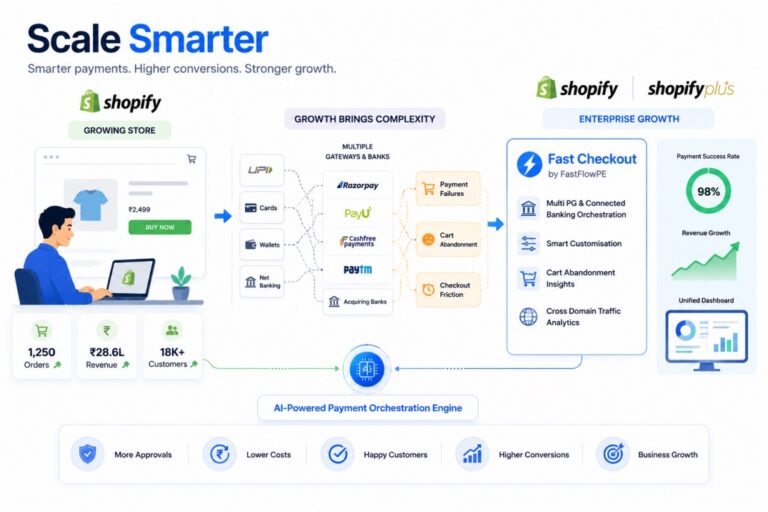
Rather than swapping one gateway for another, most high-growth merchants now combine several gateways under a single orchestration layer that decides, transaction by transaction, where a payment should go.
How Smart Payment Routing Actually Works
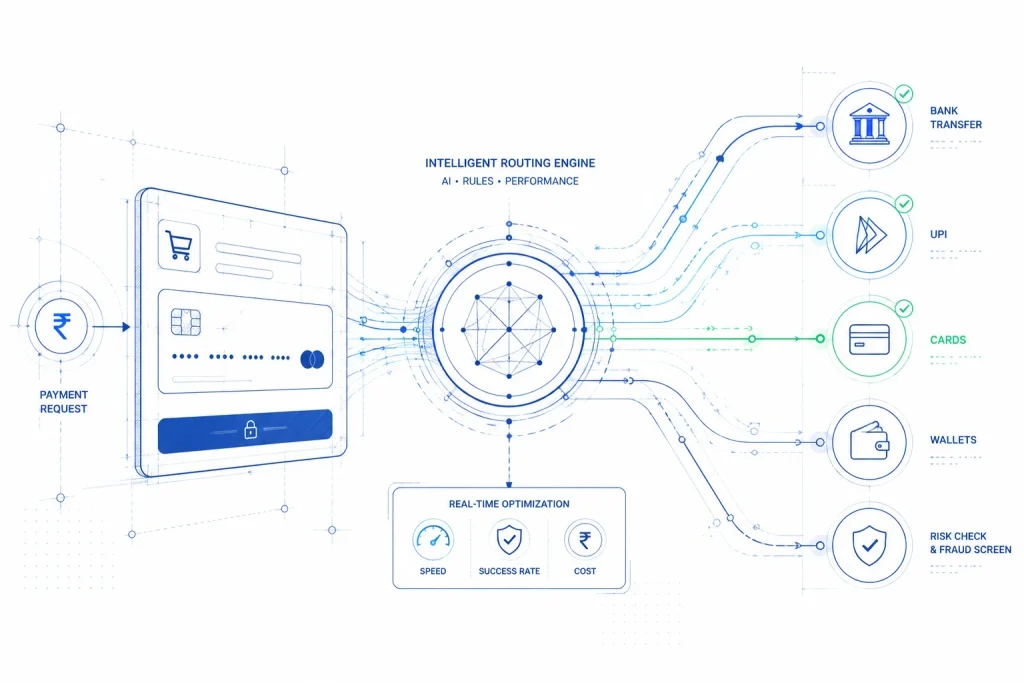
A payment orchestration platform sits between checkout and the banks, and makes a routing decision for every transaction based on:
- Current gateway uptime and latency
- Historical success rate for that payment method and bank combination
- Payment method (UPI, card, net banking, wallet, BNPL)
- Transaction value and geography
- Merchant-defined rules
The flow looks like this:
Customer checks out → Orchestration layer evaluates gateway uptime, bank availability, payment method, and success-rate history → Best-performing gateway is selected → Bank authorizes → Payment completes.
A practical example: An electronics retailer running a flash sale sees transaction volume jump 5x. Without orchestration, every transaction hits one gateway, which congests and starts failing. With multi-gateway routing, card payments might route to Gateway B, UPI to Gateway C, and net banking to Gateway A — and if Gateway B slows down mid-sale, traffic shifts automatically. The customer never sees any of this; they just complete checkout.
What Payment Orchestration Adds Beyond Routing
- Smart routing — selects the best-performing gateway per transaction in real time
- Improved uptime — no single provider outage can take down checkout
- Fewer failed retries — customers are less likely to hit a dead end and abandon
- One dashboard, not five integrations — merchants manage multiple providers through a single interface
- Unified analytics — gateway-by-gateway success rates in one report, instead of stitching together data from each provider separately
How FastFlowPe Fits In
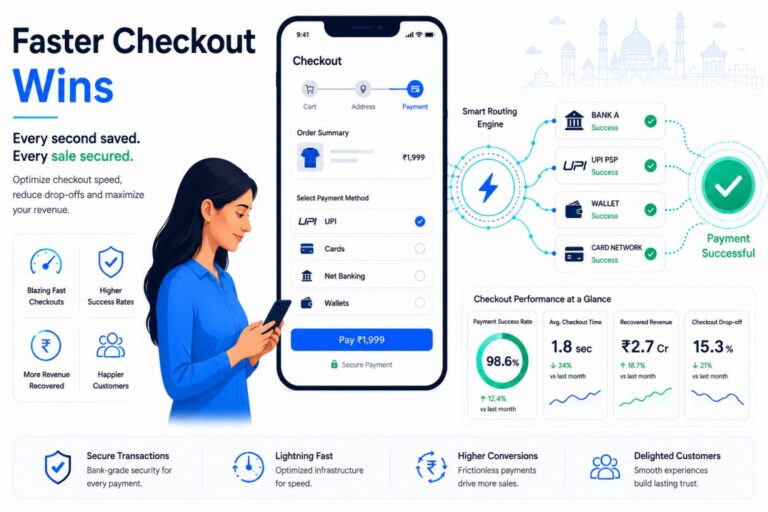
FastFlowPe’s Smart Routing evaluates every connected payment partner in real time — live success rates, health status, and response times — and sends each transaction to the one most likely to succeed. If a PSP’s success rate drops below a set threshold, traffic shifts automatically to a healthy gateway, with failover completing in under 200 milliseconds and no manual intervention.
What this looks like in practice:
- +15% success rate lift from intelligent routing versus single-gateway setups
- <200ms automatic failover if a primary PSP goes down mid-transaction
- 10+ payment partners connectable through one dashboard — including Cashfree, PayU, and major banks like ICICI and South Indian Bank
- 48-hour go-live from sign-up to first live transaction
- 99.9% uptime SLA
Merchants can also layer their own rules on top of the automatic routing — sending high-value transactions to a trusted PSP, splitting volume by percentage across gateways to manage cost and processing limits, or pinning specific payment methods (UPI, cards, net banking) to specific providers. All of this is configurable from a dashboard, without code changes.
The product suite extends beyond routing to Fast Checkout, Smart ePOS, Payment Links, and payout tools like Bulk Payouts and Multi VA — covering both collections and disbursements under one integration.
Pre-Sale Checklist
- Confirm you’re not routing 100% of volume through a single gateway
- Pull last quarter’s gateway-wise success rates
- Set routing rules by payment method (UPI, cards, net banking, wallets)
- Confirm backup acquiring relationships are active, not just contracted
- Review payment analytics weekly, not just after a sale
- Stress-test checkout on mobile and desktop before the campaign
- Re-check infrastructure capacity two weeks before any major sale event
Frequently Asked Questions
What is a Multi-Gateway Payment Strategy? An approach where a business connects multiple payment gateways and routes each transaction to the provider most likely to succeed, based on real-time performance and business rules.
Why do payments fail more often during peak sales? High transaction volume increases load on gateways and banks simultaneously, which raises the odds of congestion, latency, or timeout-related failures compared to normal traffic conditions.
Is managing multiple payment gateways difficult? Managing them individually is. A payment orchestration platform consolidates multiple gateway integrations into one dashboard and one set of routing rules.
Does a multi-gateway setup guarantee higher payment success? No platform can guarantee a success rate — bank-side issues are outside any gateway’s control. What multi-gateway routing does is reduce the blast radius when one provider underperforms, by shifting traffic elsewhere automatically. FastFlowPe’s Smart Routing, for example, has driven a 15% success rate lift versus single-gateway setups through real-time PSP evaluation and sub-200ms failover.
Which businesses benefit most from this approach? High-growth ecommerce brands, D2C businesses, marketplaces, and subscription platforms processing meaningful transaction volume — particularly those with seasonal or campaign-driven traffic spikes.
Key Takeaways
- A Multi-Gateway Payment Strategy helps ensure your payment infrastructure can handle peak traffic and maximize conversions.
- A single gateway is a single point of failure under load.
- Multi-gateway routing shifts traffic away from underperforming providers in real time.
- Orchestration platforms simplify management even as the number of gateways grows.
- Intelligent routing has been shown to lift payment success rates by up to 15% versus relying on a single gateway.