
Intelligent Commerce Stack: The Future of Digital Commerce

Digital commerce has evolved. Has your technology stack?
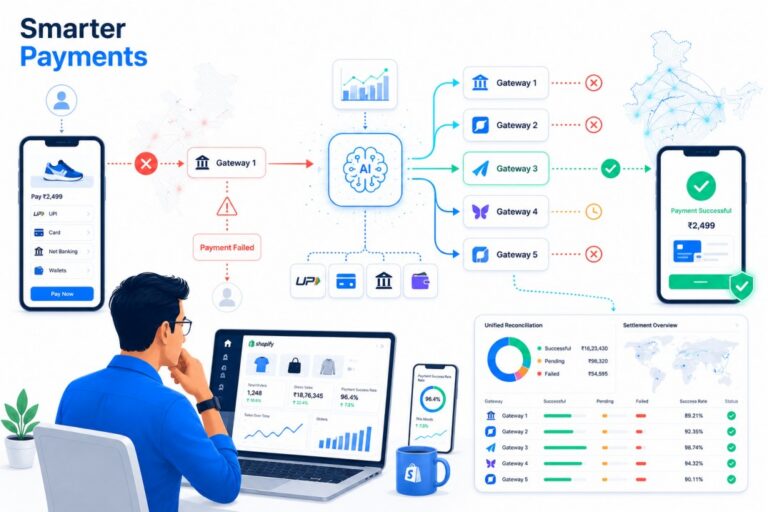
Imagine this. A customer discovers your brand on Instagram, visits your Shopify store, adds products to the cart, and proceeds to checkout. They choose UPI, but the payment fails because a payment service provider is down. Frustrated, they abandon the purchase and buy from a competitor instead.
The lost sale wasn’t caused by your product, pricing, or marketing. It was caused by fragmented commerce infrastructure.
This is a growing challenge for modern merchants. As customer expectations and payment ecosystems evolve, businesses need more than a payment gateway. They need an Intelligent Commerce Stack, a connected ecosystem that unifies checkout, payments, banking, analytics, and automation to deliver smoother customer experiences, better payment performance, and greater operational efficiency.
The Scale of the Opportunity
India’s digital payment volumes make the case for connected infrastructure concrete:
- UPI processed 23.2 billion transactions worth ₹29.9 lakh crore in May 2026, its highest-ever monthly volume.
- UPI now accounts for roughly 81–85% of India’s retail digital payment volume.
- India holds close to 49% of global real-time payment transaction volume — more than three times Brazil’s Pix share.
Source: National Payments Corporation of India (NPCI) data, reported via ANI, June 2026
At this scale, even small drops in payment success rate translate into meaningful revenue loss — which is why routing and orchestration matter more as volume grows.
Why Traditional Commerce Infrastructure Is No Longer Enough
The ecommerce landscape has changed dramatically over the past few years.
Customers expect instant checkouts, multiple payment options, real-time refunds, flexible EMI choices, and consistent experiences across devices. At the same time, merchants must manage increasing payment complexity while keeping operational costs under control.
Many businesses still rely on multiple disconnected platforms:
- One payment gateway
- Another payout solution
- Separate banking dashboards
- Individual analytics tools
- Manual reconciliation systems
- Independent fraud management solutions
Each tool may work well independently, but together they create operational silos.
This often results in:
- Higher payment failure rates
- Longer settlement cycles
- Complex reconciliation
- Increased engineering effort
- Poor visibility into transaction performance
- Slower decision making
As businesses scale, these inefficiencies multiply.
Instead of helping growth, technology begins to slow it down.
The Rise of the Intelligent Commerce Stack
The next generation of commerce is built around connected infrastructure rather than isolated software.
An Intelligent Commerce Stack integrates every critical commerce function into one coordinated ecosystem.
It typically includes:
| Component | Purpose |
| Smart Checkout | Optimizes customer payment experience |
| Payment Orchestration | Connects multiple PSPs and payment gateways |
| Smart Routing | Directs payments through the best-performing route |
| Connected Banking | Simplifies settlements and fund management |
| Merchant Analytics | Provides actionable payment insights |
| Automation | Reduces manual operational work |
Rather than replacing existing systems, this architecture connects them intelligently, allowing businesses to maximize the value of their existing investments.
Industry Trends Driving Intelligent Commerce
India has become one of the world’s most dynamic digital payment markets.
The widespread adoption of UPI, increasing ecommerce penetration, and continuous innovation in payment technology have fundamentally changed customer expectations.
Organizations such as the Reserve Bank of India (RBI) and the National Payments Corporation of India (NPCI) continue to strengthen the country’s payment ecosystem through regulatory improvements, interoperability, and digital payment initiatives.
Meanwhile, businesses are adopting:
- AI-powered decision making
- Server-side analytics
- Embedded finance
- Headless commerce
- Real-time payment intelligence
- Connected financial infrastructure
These trends point toward one clear direction.
Commerce is becoming increasingly intelligent, automated, and data driven.
The Hidden Cost of Fragmented Commerce Systems
Many merchants underestimate how much fragmented infrastructure affects business performance.
The impact goes far beyond payment failures.
Lost Revenue
Every failed transaction represents more than a single lost order.
It also means:
- Higher customer acquisition costs
- Reduced customer lifetime value
- Lower conversion rates
- Missed repeat purchases
Operational Complexity
Managing multiple payment providers often requires:
- Separate dashboards
- Manual reconciliations
- Engineering maintenance
- Vendor coordination
- Complex reporting
As transaction volumes increase, operational overhead grows rapidly.
Poor Customer Experience
Modern customers expect simplicity.
A slow checkout, unavailable payment option, or delayed refund can significantly reduce trust.
Since switching brands requires only a few clicks, customer patience has become increasingly limited.
Why Payment Orchestration Is Becoming Essential
Traditional payment gateways process payments.
Payment orchestration manages the entire payment ecosystem.
Instead of depending on one provider, merchants can connect multiple gateways, banks, and payment methods through a centralized orchestration layer.
This enables:
- Intelligent payment routing
- Improved transaction reliability
- Greater operational flexibility
- Better visibility across payment performance
- Simplified integrations
For growing businesses, this creates resilience.
If one payment route experiences downtime or reduced performance, transactions can be directed through alternative providers, depending on merchant configuration.
FastFlowPe’s Perspective: Building an Intelligent Commerce Stack
At FastFlowPe, the goal extends beyond payment processing.
The platform is designed to help merchants build a connected commerce infrastructure that adapts to changing customer expectations and business growth.
Key capabilities include:
Smart Checkout
A streamlined checkout experience that supports multiple payment methods while reducing unnecessary friction.
Payment Orchestration
Connect multiple payment gateways, banks, and payment service providers through a unified infrastructure instead of managing separate integrations.
Smart Routing
Transactions can be routed intelligently based on predefined merchant rules, helping improve payment reliability and optimize processing paths.
Connected Banking
Gain better visibility into settlements, payouts, and banking operations from a centralized platform, reducing manual effort and improving financial control.
Merchant Analytics
Actionable insights into payment performance, success rates, customer behavior, and operational trends support informed decision-making.
Rather than functioning as isolated features, these capabilities work together as a unified commerce ecosystem, helping merchants simplify operations and build a more resilient digital commerce infrastructure.
A Practical Merchant Example
Consider a fast-growing D2C skincare brand selling through Shopify.
The business invests heavily in Meta Ads and influencer marketing, attracting thousands of visitors daily. Traffic is strong, products are popular, and customers reach the checkout page. However, the team notices that many transactions fail during peak hours due to gateway downtime. Finance teams spend hours reconciling settlements across different payment providers, while operations teams manually manage refunds and payouts.
Instead of adding more tools, the brand adopts an intelligent commerce stack.
They connect multiple payment gateways through a payment orchestration layer, enabling Smart Routing to automatically select the best-performing provider based on predefined rules. Connected Banking centralizes settlement visibility, while Merchant Analytics provides insights into payment success rates and customer behavior.
The result is not just improved payment performance. The business also gains operational efficiency, better visibility into cash flow, and a checkout experience that inspires greater customer confidence. Depending on the merchant’s implementation and business model, this type of infrastructure can help reduce friction and support scalable growth.
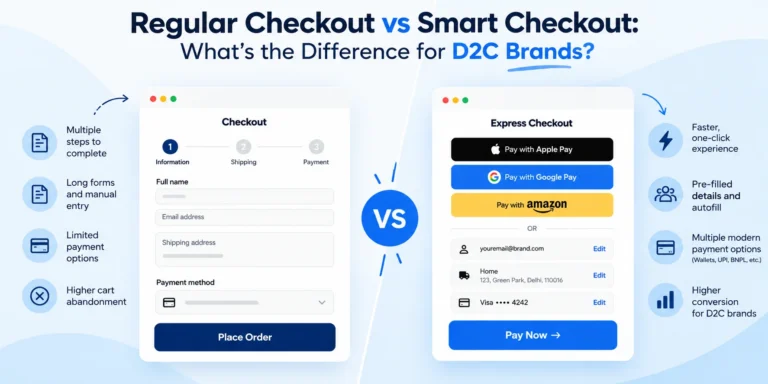
Traditional Commerce Stack vs Intelligent Commerce Stack
| Traditional Commerce Stack | Intelligent Commerce Stack |
| Single payment gateway | Multiple gateways through orchestration |
| Static payment routing | Intelligent Smart Routing |
| Separate banking portals | Unified Connected Banking |
| Manual reconciliation | Automated financial visibility |
| Limited payment analytics | Real-time merchant insights |
| Difficult to scale | Designed for business growth |
| Higher operational effort | Streamlined operations |
| Reactive issue management | Data-driven optimization |
The key difference is that traditional systems react to problems after they occur, while an intelligent commerce stack is designed to anticipate, adapt, and optimize continuously.
The Future of Digital Commerce
Digital commerce is moving beyond online stores and payment gateways. The next phase is about intelligent infrastructure that connects every part of the transaction lifecycle.
Several trends are shaping this future:
AI-Powered Payment Decisions
Artificial intelligence is beginning to optimize payment routing, identify transaction risks, and recommend improvements based on historical payment data. Rather than relying on fixed rules, businesses can use predictive insights to make smarter operational decisions.
Intelligent Checkout Experiences
Future checkouts will adapt to customer behavior in real time. Preferred payment methods, personalized offers, EMI options, and localized payment experiences can all contribute to reducing friction and improving customer satisfaction.
Connected Financial Infrastructure
Commerce platforms, banks, payment providers, and accounting systems are becoming increasingly interconnected. This reduces manual work and provides merchants with a unified view of financial operations.
Predictive Commerce Analytics
Instead of simply reporting what happened, analytics platforms are evolving to answer questions such as:
- Which payment methods perform best?
- Which gateway has the highest success rate?
- Where are customers abandoning checkout?
- Which regions experience the most payment failures?
These insights enable merchants to make proactive decisions rather than reactive fixes.
Best Practices for Building an Intelligent Commerce Stack
Businesses planning to modernize their commerce infrastructure should consider the following best practices:
- Support multiple payment gateways instead of relying on a single provider.
- Prioritize a fast, mobile-friendly checkout experience.
- Use Smart Routing to improve payment reliability.
- Monitor payment success rates regularly.
- Automate reconciliation wherever possible.
- Centralize payment and banking data.
- Continuously analyze customer checkout behavior.
- Select infrastructure that can scale with business growth.
Common Mistakes to Avoid
Many merchants unintentionally create operational challenges while trying to expand their payment capabilities.
Common mistakes include:
- Depending on a single payment gateway.
- Managing multiple payment providers manually.
- Ignoring payment analytics.
- Optimizing only for transaction costs instead of customer experience.
- Delaying infrastructure upgrades until operational issues become severe.
Building a modern commerce stack is easier and more cost-effective when approached proactively.
Merchant Implementation Checklist
Use this checklist to evaluate your current commerce infrastructure:
- Multiple payment gateways integrated
- Smart payment routing enabled
- Mobile-first checkout experience
- UPI, cards, wallets, and EMI supported
- Centralized payment analytics dashboard
- Automated reconciliation process
- Connected banking visibility
- Regular payment performance monitoring
- Scalable infrastructure for future growth
- Compliance with RBI and NPCI guidelines where applicable
If several of these areas are missing, it may be time to evaluate a more integrated commerce infrastructure.
Frequently Asked Questions
1. What is an Intelligent Commerce Stack?
An Intelligent Commerce Stack is a connected ecosystem combining checkout, payment orchestration, banking, analytics, and automation to help businesses manage digital commerce more efficiently.
2. How is a payment gateway different from payment orchestration?
A payment gateway processes transactions through one provider. Payment orchestration connects multiple gateways and PSPs so merchants can manage payments through a single unified platform.
3. Why is Smart Routing important?
Smart Routing sends transactions through the best-performing payment route based on predefined rules, improving reliability and reducing failed transactions.
4. Can small businesses benefit from an Intelligent Commerce Stack?
Yes. Businesses of any size can benefit from simplified operations and better payment visibility, though the implementation scope varies with transaction volume.
5. What role does Connected Banking play?
Connected Banking centralizes visibility into settlements, payouts, and banking operations, reducing manual reconciliation for finance teams.
6. Is an Intelligent Commerce Stack only for ecommerce businesses?
No. Marketplaces, SaaS platforms, subscription businesses, and fintech companies with complex payment operations benefit from it too.
Key Takeaways
An Intelligent Commerce Stack is no longer just a technology upgrade. It is a strategic foundation for modern digital commerce.
Businesses that connect payments, banking, analytics, and automation into one ecosystem are better positioned to improve customer experiences, simplify operations, and adapt to changing market demands.
As payment ecosystems continue to evolve, merchants will increasingly compete not only on products and pricing but also on the quality and reliability of their commerce infrastructure.
FastFlowPe supports this evolution by bringing together Smart Checkout, Payment Orchestration, Smart Routing, Connected Banking, and Merchant Analytics into a unified platform designed to help businesses build resilient, scalable commerce operations.
Conclusion
The future of digital commerce belongs to businesses that think beyond isolated payment tools and embrace connected infrastructure.
An Intelligent Commerce Stack enables merchants to streamline payment operations, improve customer experiences, and make informed decisions through unified data and automation. Rather than managing disconnected systems, businesses can build a commerce ecosystem that is flexible, scalable, and ready for the next phase of digital growth.
Whether you’re an emerging D2C brand, a growing SaaS platform, or an enterprise handling high transaction volumes, investing in intelligent commerce infrastructure today can help prepare your business for tomorrow’s opportunities.
Ready to modernize your payment infrastructure? Explore how FastFlowPe’s Payment Orchestration, Smart Checkout, and Connected Banking solutions can help you build a smarter commerce ecosystem.