
Why Shopify Stores Lose Revenue to Payment Gateway Limitations
Shopify payment gateway limitations are the quietest revenue leak in Indian D2C, and they rarely show up as a dramatic event on your dashboard. Picture 9 PM on a sale night. Your ad spend is firing, your traffic graph is vertical, and your founder-brain is finally relaxing. Then the tickets start: “Payment failed.” “Money deducted, no order.” “Tried three times, gave up.” By morning, therefore, you’ve paid for the clicks but lost the carts.
Here’s the uncomfortable truth. Most Shopify stores aren’t losing customers because shoppers don’t want to buy. Instead, they lose them in the last ten seconds of the journey, where a single payment processor decides whether revenue lands or evaporates.
The Market Moved On — But Most Checkouts Didn’t
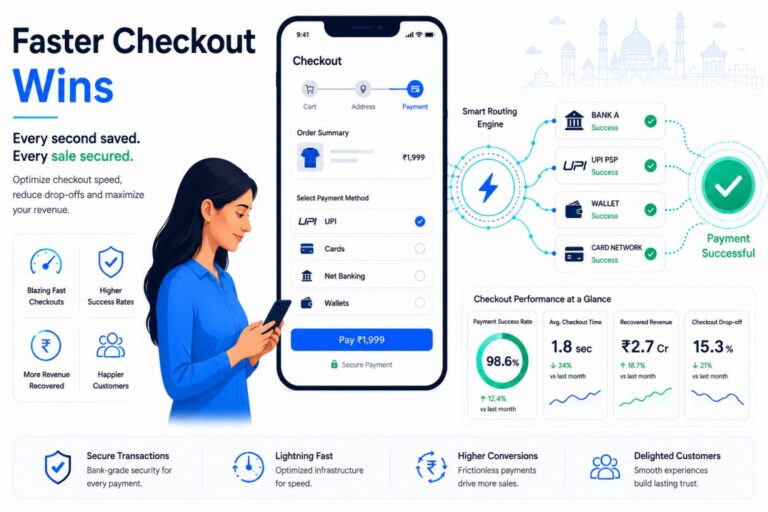
India’s payment rails are now genuinely world-class. According to NPCI data, UPI crossed 23 billion transactions in May 2026, while rail-level success rates sit close to 99%. In other words, the plumbing works beautifully.
So why do payments still fail? Because the failure rarely lives in the rail. Instead, it lives in the infrastructure layer above it, the routing, retries, and gateway logic between your Shopify checkout and the bank. Consequently, when one processor has a bad moment during a flash sale, the shopper simply sees a spinning loader, and intent dies.
Why Shopify Payment Gateway Limitations Trigger Failed Payments
A single-gateway setup carries three structural weaknesses that no amount of marketing budget can fix.
One Gateway, One Point of Failure
- A fixed failure rate. If your processor declines 4% of card payments, then you lose 4 in every 100, permanently, on autopilot.
- No failover. If the gateway slows down for fifteen minutes during a launch, your entire revenue stream stalls with it.
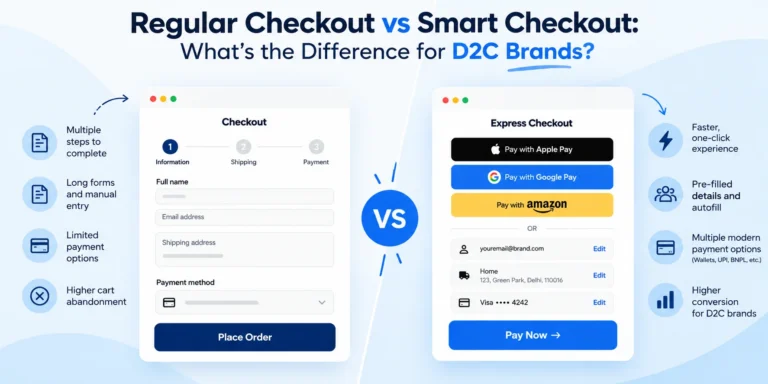
- Checkout friction. Returning customers re-enter the same address every time, which stretches a 20-second action into a 90-second chore.
Ultimately, this is the behavioural heart of the issue. Buying intent peaks at checkout and decays with every extra second of friction. As a result, a failed transaction doesn’t just lose a sale, it breaks trust at the exact moment trust matters most.
What the Research Reveals About Checkout Drop-Off
The data backs up the late-night chaos. For example, the Baymard Institute puts the average documented checkout abandonment rate at roughly 70%, and Indian benchmarks often run higher.
Moreover, a 2025 survey of 1,000 Indian online shoppers found that 52.8% abandoned because checkout felt too long or complicated. Nearly 1 in 5 dropped off simply because their preferred payment method wasn’t available. In short, a meaningful slice of lost revenue has nothing to do with price or product. It’s pure infrastructure friction, exactly the category of Shopify payment gateway limitations that brands rarely measure.
The Hidden Cost of Revenue Leakage
The damage stays invisible precisely because it’s distributed. A 3% lift in payment success doesn’t appear as a dramatic event. Instead, it shows up as a quietly better month. The reverse is also true, however: a chronic failure rate silently taxes every campaign you run.
Consider the math. If re-acquiring a single dropped customer costs ₹300–₹1,000 in retargeting, then every preventable failure isn’t one lost sale, it’s the lost sale plus the cost of winning that customer back. Across a full sale season, therefore, the leak becomes a flood.
The FastFlowPe Framework — From Single Gateway to Smart Orchestration
This is where the model changes. FastFlowPe is not a payment gateway. Rather, it’s a payment orchestrator that sits abovegateways like Cashfree, PayU and Easebuzz and manages the entire payments lifecycle. Consequently, orchestration directly fixes the Shopify payment gateway limitations described above.
The framework is simple:
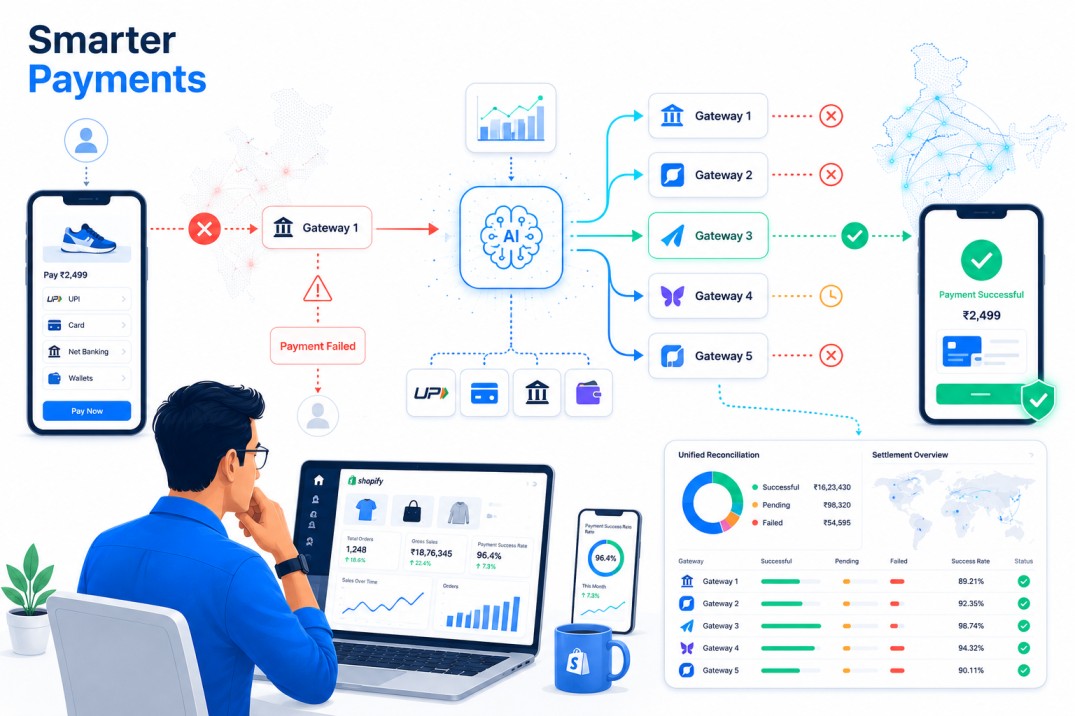
- Route intelligently. FastFlowPe connects to 15+ PSPs and sends each transaction to the processor with the highest live success rate.
- Fail over automatically. If one PSP stumbles, the transaction instantly retries on another. As a result, this reduces payment failures by 30–50%.
- Remove friction. A returning customer is recognised via mobile OTP, while address auto-fill cuts checkout from 90 seconds to under 20.
- Unify the view. Finally, every Collection and Disbursement is tracked in one dashboard, no manual reconciliation across providers.
A Quick Real-World Picture
Imagine a fashion D2C brand on Shopify running a Diwali flash sale. On a single gateway, a mid-sale issuer slowdown would have quietly killed a chunk of card payments at peak traffic. With orchestration, however, those same transactions re-route to a healthier PSP in milliseconds. The shopper never notices the save, which is exactly the point. So the brand simply ends the night with the revenue it actually earned.
Where Payments Are Heading — AI-Powered Routing
The next frontier isn’t just more gateways. Instead, it’s smarter routing. Predictive systems are beginning to anticipate which processor will succeed for a given card, bank, and time of day before the transaction is attempted. Furthermore, pair that with AI-based RTO risk scoring for COD orders and dynamic, OTP-first checkout, and the checkout stops being a leaky funnel and becomes a conversion engine. For mobile-first, UPI-led, COD-heavy Indian D2C, above all, this intelligence layer is fast becoming the difference between scaling profitably and scaling a problem.
Conclusion:
Stop Paying the Single-Gateway Tax
Shopify payment gateway limitations aren’t a flashy problem, they’re a slow one, which is exactly why they’re so expensive. The brands that win the next phase of Indian commerce won’t be the ones with the biggest ad budgets. Rather, they’ll be the ones who stop losing customers at the last ten seconds. Ultimately, orchestration turns payment from a single point of failure into a resilient, intelligent system.
Curious how much revenue your checkout is quietly leaking? FastFlowPe goes live in 48 hours, one API, one onboarding call. Let’s audit your payment flow.
FAQ Section
1. Why do Shopify payments fail even when the customer’s bank is fine? Most failures happen in the infrastructure layer between Shopify and the bank, gateway timeouts, overloads, or issuer declines on a single processor. Because there’s only one gateway, there’s no fallback, so a temporary glitch becomes a permanent lost sale.
2. How can I improve my Shopify payment success rate? Route transactions across multiple payment service providers instead of relying on one. For instance, a payment orchestrator like FastFlowPe sends each payment to the PSP with the highest live success rate and retries automatically, reducing failed payments by 30–50%.
3. What’s the difference between a payment gateway and a payment orchestrator? A gateway processes a transaction through one connection. An orchestrator, however, sits above multiple gateways, adding failover, smart routing, and unified reconciliation that a single gateway can’t offer.
4. Does adding multiple gateways to Shopify mean more integration work? Not with orchestration. Instead, FastFlowPe connects you to 15+ PSPs through a single API and one onboarding call, so you integrate once and go live in 48 hours.
5. How do payment gateway limitations affect cart abandonment in India? Indian shoppers are mobile-first and friction-sensitive. As surveys show, many abandon checkout because it’s too long or their preferred method is missing. Therefore, failed or clunky payments directly inflate abandonment.
6. Can better payment routing really increase revenue? Yes. Recovering even a few percentage points of failed payments compounds across every campaign. Since re-acquiring a dropped customer can cost ₹300–₹1,000, preventing the failure is far cheaper than chasing it.
7. Is payment orchestration only for large enterprises? No. FastFlowPe is built for growth-stage D2C and SMB brands, bringing the same multi-PSP architecture and marketplace MDR rates that large platforms use, accessible at any scale.