
AI-Powered Checkout Optimization: The Future of Ecommerce in India
Why the last 30 seconds of the buying journey decide everything
The Moment Every Merchant Fears
AI-powered checkout optimization is changing how ecommerce businesses reduce payment failures, improve customer trust, and increase successful transactions. Imagine a customer who spends eleven minutes browsing your store, compares products, adds items to the cart, and finally clicks “Pay Now.” Instead of a smooth payment, they encounter an error, abandon their purchase, and may never return.
A customer spends eleven minutes browsing your store. They compare variants, read three reviews, add a product to their cart, and finally click “Pay Now.” Then — a spinner. Ten seconds. Twenty. A vague error message. They refresh. They try again. And then they leave, never to return.
This isn’t a rare edge case. It is the single most expensive, most preventable failure point in Indian ecommerce. Industry analyses of Indian online shopping behaviour put cart abandonment as high as 75%, with payment friction — not price, not shipping — cited as the leading cause. Bank server timeouts, delayed OTPs, and limited payment options are consistently identified as the biggest drivers of checkout drop-off in India.
For a merchant doing ₹50 lakh a month in gross sales, even a few percentage points of recoverable abandonment represents lakhs of rupees walking out the digital door — every single month.
This is the problem AI-powered checkout optimization exists to solve — not by making checkout “smarter” as a marketing slogan, but by making it faster, more resilient, and more personal at the exact moment a customer is deciding whether to trust you with their money.
Quick Answer: What AI-Powered Checkout Optimization Actually Changes
For readers who want the summary before the detail — here’s what shifts when a checkout stack adds an AI intelligence layer, versus a standard single-gateway setup.
| Checkout Element | Standard / Single-Gateway Checkout | AI-Powered Checkout Optimization |
|---|---|---|
| Payment routing | Fixed path through one gateway; no fallback on failure | Real-time routing across multiple PSPs, with automatic fallback |
| Fraud screening | Static rules applied uniformly to every transaction | Risk-scored per transaction using behavioural and device signals |
| Payment methods shown | Same list for every customer | Prioritized by the customer’s own payment history, where available |
| Failure visibility | Success/failure totals only | Failure-reason-level analytics by gateway and issuing bank |
| Settlement & reconciliation | Manual cross-checking across gateway dashboards | Centralized visibility through Connected Banking |
This table is the shape of the argument; the rest of the article is the evidence and the “why” behind each row.
The Indian Payment Ecosystem Has Changed — Checkout Hasn’t Kept Up
India’s digital payment infrastructure has scaled at a pace few countries can match. NPCI data shows UPI processed over 23 billion transactions worth close to ₹30 lakh crore in a single month in 2026, averaging more than 700 million transactions a day. UPI now accounts for the vast majority of India’s retail digital payment volume, and India alone represents roughly half of all real-time payment transactions processed globally.
That is a staggering achievement in rails and infrastructure. But rails alone don’t guarantee a smooth checkout. Each UPI app has its own success and latency profile. Banks operate with different uptime patterns, while acquirers apply their own approval logic based on the time of day, transaction value, and customer risk profile. NPCI has also introduced volume caps to prevent any single UPI app from dominating the ecosystem, making merchant traffic increasingly fragmented.
The result: a merchant relying on a single payment gateway or a single UPI handle is, structurally, always going to see some transactions fail that didn’t need to fail. Multiply that across lakhs of transactions and it becomes a leading cause of silent revenue leakage.
AI-powered checkout optimization is emerging as a response to an increasingly complex payment landscape. As AI adoption accelerates across retail, checkout remains one of the most underutilized opportunities for improving customer experience and conversion.
Where Checkout Actually Breaks: A Problem Analysis
Before layering AI onto anything, it’s worth being precise about what’s actually going wrong at checkout. Broadly, the failure points fall into four categories.
1. Technical bottlenecks Static, rule-based checkout flows route every transaction the same way, regardless of issuing bank load, acquirer downtime, or network congestion. When one route degrades, merchants relying on a single gateway have no fallback — the transaction simply fails.
2. Customer psychology Trust is fragile at the payment step. A checkout page that asks for too much information, forces account creation, or displays an unfamiliar payment option can trigger hesitation even when the customer fully intends to buy. Roughly a quarter of shoppers abandon carts when forced to create an account before checkout, and a meaningful share abandon when their preferred payment method isn’t available.
3. Operational inefficiencies Manually reconciling failed transactions, chasing down which gateway declined which order, and investigating fraud flags after the fact consumes finance and ops bandwidth that most D2C and mid-market teams simply don’t have.
4. One-size-fits-all checkout design A repeat customer with three years of order history is shown the exact same checkout flow as a first-time visitor on a shared device. Neither the risk assessment nor the experience is calibrated to who’s actually paying.
AI doesn’t eliminate these problems by itself — but it gives merchants a way to detect, predict, and route around them in real time, rather than discovering them in a monthly reconciliation report.
What the Research Actually Shows
It’s worth separating fact from hype here, because “AI checkout” has become something of a buzzword.
Baymard Institute research shows that improving checkout usability alone can increase conversions by over 35% for large ecommerce sites. While this isn’t an AI-specific finding, it highlights the significant opportunity AI-powered checkout intelligence can unlock by reducing friction through automation.
Overly strict fraud rules can cost businesses more than fraud itself. AI-powered risk scoring helps reduce false declines by accurately distinguishing legitimate transactions from genuinely risky ones, protecting both revenue and customer experience.
Mobile cart abandonment is significantly higher than desktop, making AI-powered payment retries and intelligent routing especially valuable in mobile-first markets like India.
Bodies such as NASSCOM, RBI, and NPCI have all pointed, in different ways, to the same structural shift: as digital payment volumes grow, the burden shifts from “can this transaction technically go through” to “can this transaction go through reliably, securely, and fast enough that the customer doesn’t lose patience.” AI-based orchestration is one of the more credible technical responses to that shift — not a guaranteed fix, but a system designed to reduce avoidable failure.
Trust note: No payment technology — AI-based or otherwise — can guarantee a specific conversion lift or failure-rate reduction. Actual outcomes depend heavily on a merchant’s existing gateway mix, customer base, ticket size, and implementation quality. The frameworks below describe what AI-powered checkout is designed to do, not a promised outcome.
Definition Box: What Does “AI-Powered Checkout” Actually Mean?
AI-powered checkout refers to a payment experience layer where machine learning models continuously analyze transaction signals — issuing bank performance, network latency, device and behavioural data, past purchase history, and fraud indicators — to make real-time decisions about how a transaction is routed, verified, and presented to the customer. It typically spans three layers:
- Intelligence layer — models scoring risk, predicting success probability, and identifying the optimal payment path
- Orchestration layer — the infrastructure that actually executes routing decisions across multiple gateways, acquirers, and banks
- Experience layer — the checkout UI itself, adapting payment options, forms, and messaging to the individual shopper
Business Impact: What Checkout Friction Actually Costs
The financial impact of checkout friction shows up in three distinct places on a merchant’s P&L, even when it isn’t labelled as such.
| Impact Area | What It Looks Like | Why It’s Often Missed |
|---|---|---|
| Revenue leakage | Successful “intent to pay” that never converts due to a failed or slow transaction | Rarely tracked separately from general cart abandonment |
| Customer trust erosion | Customers who had a failed payment become less likely to return, even if the money is refunded | Refund success is tracked; retention impact usually isn’t |
| Operational cost | Support tickets, manual reconciliation, and gateway-switching investigations | Buried across finance, ops, and support headcount |
Cart abandonment costs ecommerce businesses billions every year, with payment failures remaining a leading cause in India. AI-powered checkout intelligence helps reduce this friction, turning checkout into a measurable growth and revenue driver.
The Fastflowpe Insight Framework: How AI Fits Into the Checkout Stack
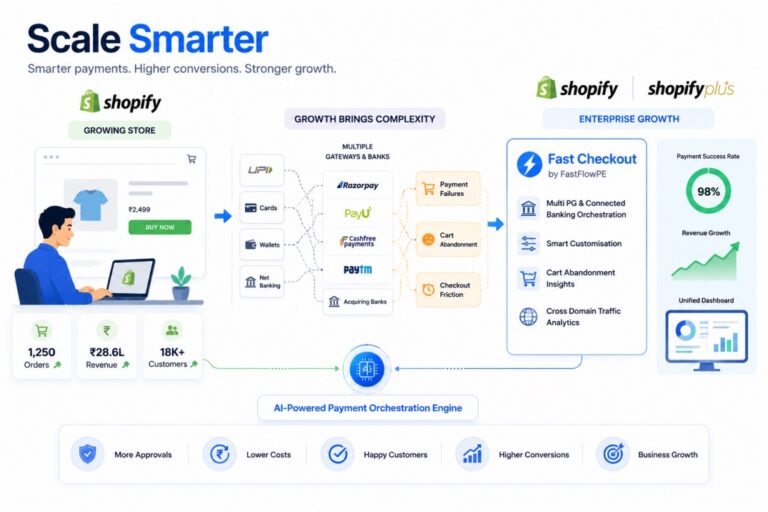
Fastflowpe approaches AI-powered checkout optimisation not as a single feature, but as a layer that runs across four connected capabilities. Each capability addresses a specific problem area, with results depending on the merchant’s implementation and existing payment setup.
Smart Checkout
A checkout experience designed to adapt to the shopper rather than presenting a static, identical flow to everyone. This can include prioritizing a customer’s previously successful payment method, minimizing redundant form fields, and supporting guest checkout to reduce the friction identified earlier.
Payment Orchestration & Smart Routing
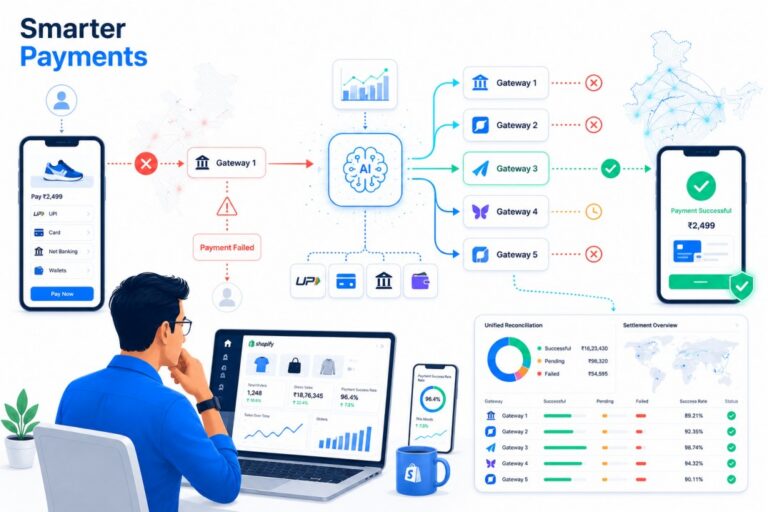
Rather than depending on a single payment gateway or acquirer, an orchestration layer can evaluate multiple PSPs in real time and route each transaction through the path most likely to succeed, based on live signals like bank uptime and historical success rates. This is the core mechanism behind Multi Gateway Routing — designed to reduce the “single point of failure” problem common in checkout stacks built around one gateway.
Connected Banking
Direct, connected access to banking rails — rather than routing every transaction through layers of intermediaries — can help reduce latency and give merchants clearer visibility into settlement and reconciliation, which in turn reduces the operational overhead described earlier.
Payment Intelligence & Merchant Analytics
Real-time and historical analytics on payment success rates, failure reasons, and issuer-level patterns give merchants (and their finance teams) visibility they typically can’t get from a single gateway dashboard — helping teams diagnose why a transaction failed rather than just that it failed.
Important distinction: These capabilities are designed to reduce avoidable payment failure and friction. They do not eliminate all checkout drop-off, which is also influenced by pricing, product fit, and shipping expectations — factors outside the payment stack itself.
Flow Diagram (Text Format): How an AI-Orchestrated Transaction Moves
Customer clicks "Pay Now"
        |
        v
[Intelligence Layer] -> Evaluates: issuing bank status, device signals,
                         historical success rate, fraud risk score
        |
        v
[Routing Decision] -> Selects optimal PSP / acquirer path in real time
        |
        v
[Orchestration Layer] -> Executes transaction via chosen route
        |
        +-- Success -> Order confirmed, receipt triggered
        |
        +-- Failure signal detected -> Automatic fallback route attempted
                                        (before customer sees an error)
This fallback step — attempting an alternate route before the customer ever sees a failure — is the single biggest structural difference between a standard single-gateway checkout and an orchestrated, AI-assisted one.
A Practical Merchant Example
Consider a mid-sized fashion D2C brand selling primarily through a Shopify storefront, doing roughly 8,000 orders a month, with UPI as the dominant payment method among its mostly mobile, Tier-2/Tier-3 customer base.
Before adopting orchestration, the brand routed 100% of transactions through a single gateway. During peak sale periods, when one issuing bank experienced elevated latency, every customer on that bank saw the same failure — regardless of whether alternate routes were available.
With a Smart Routing layer in place, the same scenario looks different: when the primary route to that issuing bank shows degraded performance, the system can attempt an alternate acquirer path automatically, before the customer ever sees a failed transaction screen. The customer experiences a normal, successful checkout; the merchant never even sees the underlying routing decision.
The result isn’t a guaranteed uplift — actual impact depends on the merchant’s specific gateway mix, customer geography, and ticket size — but it illustrates why orchestration-based routing is structurally different from simply picking “the best” single gateway.
Myth vs Reality
| Myth | Reality |
|---|---|
| “AI checkout” means a chatbot on the payment page | In practice, most AI value in checkout is invisible — routing, fraud scoring, and risk decisions happening in milliseconds |
| More payment options always mean higher conversion | Too many options can add decision fatigue; AI-driven personalization prioritizes relevant options, not all options |
| AI can guarantee zero payment failures | No system can guarantee 100% success; bank-side and network-side failures are outside any orchestration platform’s control |
| AI checkout is only for large enterprise merchants | Orchestration and routing intelligence are increasingly accessible to mid-market and growing D2C brands, not just enterprise accounts |
| Stricter fraud rules are always safer | Overly strict fraud rules can generate false declines that, industry-wide, are estimated to cost far more in lost legitimate sales than fraud itself does — calibration matters more than strictness |
Best Practices for Merchants Evaluating AI-Powered Checkout
- Audit your current payment failure rate by gateway and by issuing bank before evaluating any new platform
- Prioritize platforms that support Multi Gateway Routing rather than a single-PSP dependency
- Choose a platform that supports guest checkout and minimal-field forms out of the box.
- Ask vendors for failure-reason-level analytics, not just success/failure totals
- Evaluate mobile checkout performance separately from desktop — mobile abandonment consistently runs higher than desktop
- Confirm compatibility with your existing stack — Shopify, WooCommerce, Magento, Wix, or a headless commerce setup — before migrating
Common Mistakes to Avoid
- Treating checkout optimization as a one-time redesign rather than an ongoing, data-driven process
- Adding more payment methods without measuring which ones actually convert for your customer base
- Ignoring reconciliation and settlement visibility in favour of front-end checkout polish alone
- Assuming a single gateway’s uptime SLA reflects real-world, bank-specific performance
- Tightening fraud rules without measuring the resulting false-decline rate
Future Trends: Where Checkout Is Headed
- Predictive payment routing — models that anticipate failure before it happens, based on live bank and network signals, rather than reacting after a decline
- Deeper Connected Banking integration — more direct rails access reducing settlement lag and reconciliation overhead
- Consent-aware personalization — checkout personalization increasingly shaped by privacy-first signals, aligned with evolving Consent Mode and data-handling expectations
- Cross-platform payment intelligence — merchant analytics unifying signals across GA4, Meta Pixel, Conversion API, and payment-layer data for a fuller picture of the buying journey, from ad click to successful payment
- Address and RTO intelligence — AI increasingly extending beyond the payment moment into delivery-risk scoring for COD orders, an area particularly relevant to Indian ecommerce
- Agentic commerce — as AI shopping agents begin transacting on behalf of consumers, checkout infrastructure will increasingly need to serve machine-initiated transactions with the same reliability standards as human-initiated ones
Merchant Checklist: Is Your Checkout Ready for AI-Powered Optimization?
- I know my current payment failure rate, broken down by gateway and by bank
- I rely on more than one payment gateway or acquirer for critical volume
- I can see failure reasons, not just failure counts, in my current analytics
- My checkout supports guest purchase without forced account creation
- I’ve measured mobile vs desktop checkout conversion separately
- I know how much monthly revenue is at risk from payment-specific abandonment (as distinct from general cart abandonment)
- My current platform integrates cleanly with my commerce stack (Shopify, WooCommerce, Magento, Wix, or headless)
- I have visibility into COD-related RTO risk, if COD is a meaningful share of my orders
Key Takeaways
- Payment friction — not just price or shipping — is a leading, measurable driver of cart abandonment in Indian ecommerce
- India’s digital payment volume has scaled dramatically, but scale alone doesn’t guarantee individual transaction reliability
- AI-powered checkout optimization works primarily through three layers: intelligence (scoring and prediction), orchestration (routing), and experience (personalization)
- Multi Gateway Routing and Connected Banking reduce single-point-of-failure risk at checkout by intelligently distributing transactions across multiple payment routes.
- Over-aggressive fraud rules can cost more in false declines than they save in blocked fraud — calibration is the goal, not maximum strictness
- No platform can guarantee a specific conversion lift; outcomes vary by gateway mix, customer base, and execution
Conclusion
Checkout is the moment where a customer’s interest either converts into revenue or evaporates into a bounce. As India’s payment ecosystem grows more complex, with more apps, more banks, more routing paths, and tighter regulatory structures around market concentration, a single, static checkout flow is no longer a safe default for merchants who depend on conversion at scale.
FastFlowPe’s Smart Checkout, Payment Orchestration, and Connected Banking help merchants uncover and address the invisible issues that affect checkout performance.
Curious what your own checkout failure pattern looks like? Book a walkthrough with Fastflowpe to see where your payment stack may be leaving revenue on the table.
AI improves checkout mainly by making real-time decisions — such as selecting the payment route most likely to succeed, detecting fraud risk without adding manual friction, and personalizing which payment methods are shown to a given shopper. The impact depends on how well it’s implemented alongside a merchant’s existing gateway setup.
AI-powered checkout optimization is a payment experience layer where machine learning models analyze signals like bank performance, device data, and purchase history to route transactions intelligently and personalize the checkout flow, rather than relying on a single, static payment path for every customer.
AI-driven routing and personalization are designed to reduce payment-specific abandonment — failures caused by declined transactions, slow gateways, or missing preferred payment methods. It does not address abandonment caused by pricing, shipping costs, or product-related hesitation.
Modern risk-scoring models evaluate transaction signals in milliseconds — device fingerprinting, behavioural patterns, and historical data — allowing legitimate transactions to pass through quickly while flagging genuinely suspicious ones for additional checks, rather than applying the same friction to every transaction. This also helps address false declines, which industry research suggests cost merchants far more in lost sales than fraud itself.
Orchestration and routing intelligence, once considered enterprise-only, are increasingly accessible to mid-market and growing D2C brands. Suitability depends more on transaction volume and existing gateway complexity than on business size alone.
No. Orchestration platforms typically sit above existing gateways and acquirers, routing transactions across them intelligently, rather than replacing them outright.
Adding more payment options addresses choice; AI-powered routing addresses reliability — ensuring that once a customer picks a method, the transaction has the best available chance of succeeding on the first attempt.
Typically: live issuing-bank and acquirer performance, historical success rates by route, device and network signals, and — where available and consented to — a customer’s own prior successful payment method. None of this requires collecting more data from the customer at checkout itself.