
Why Smart e-POS Systems Are Replacing Traditional Billing Machines
A smart e-POS system is quietly retiring the humble billing machine, and the shift is bigger than a hardware upgrade. Picture a busy kirana store or a growing retail counter. The old machine did exactly one thing well: it swiped a card and spat out a receipt. Meanwhile, the owner still juggled a separate UPI QR code, a notebook for inventory, and a shoebox of slips for the accountant. Each tool lived on its own island, and none of them talked to each other.
That fragmentation is the real problem. Customers now expect to pay any way they like, and owners need to see their business in real time. Therefore, a device that only prints receipts simply can’t keep up.
The Market Has Already Moved
The numbers tell the story. According to RBI data, India’s POS terminal base crossed roughly 10.7 million machines by early 2025, up sharply from 5.8 million in 2022. Furthermore, industry analysts expect the India POS market to keep compounding at double-digit growth through the decade.
What’s driving it isn’t just more terminals — it’s smarter ones. The momentum is clearly toward cloud-native devices, SoftPOS (turning a phone into a terminal), and omnichannel acceptance. Meanwhile, NPCI data shows UPI crossed 23 billion transactions in May 2026, so any modern counter must accept UPI, cards, and QR with equal ease.
What Is a Smart POS System?
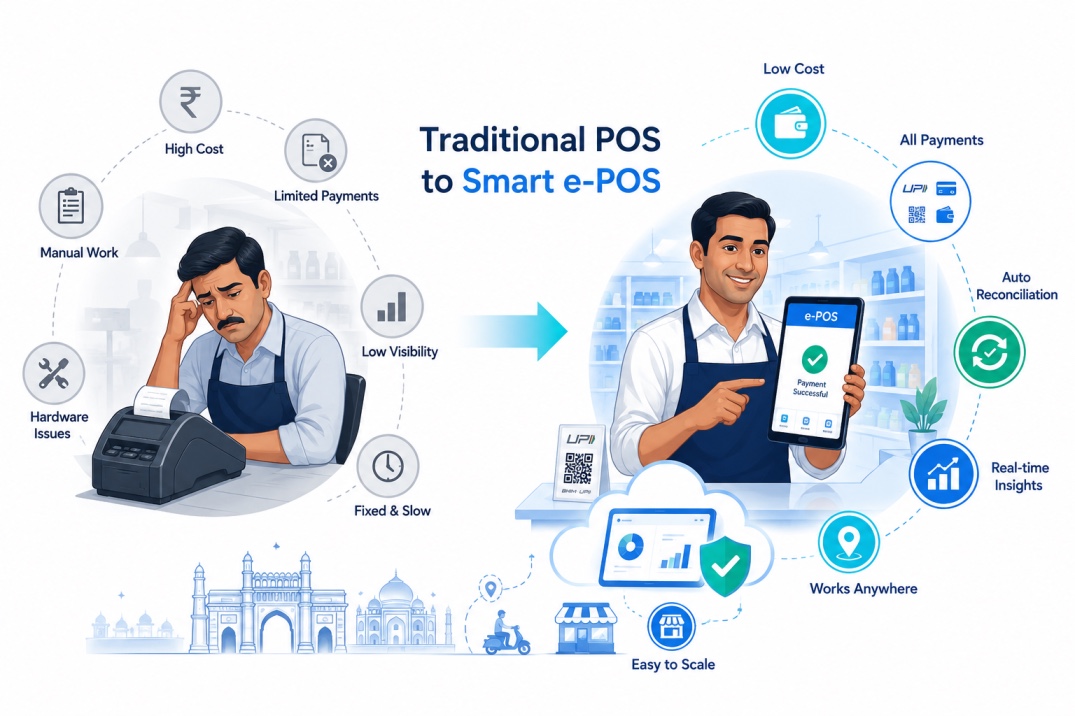
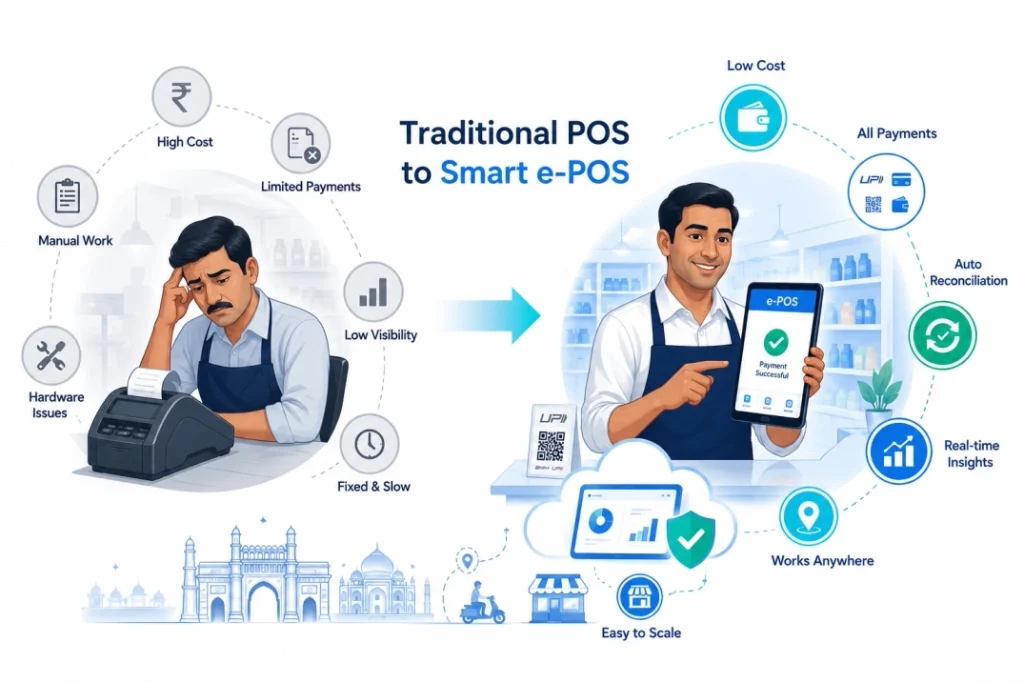
A smart POS system is a cloud-connected, app-driven device that does far more than process a payment. Specifically, it accepts every method like UPI, cards, wallets and QR, on one screen. Moreover, it syncs sales to the cloud in real time, tracks inventory, applies offers, and feeds clean data straight to your books.
In short, the billing machine was a calculator with a card reader. By contrast, the smart POS is a business management hub that happens to take payments.
Where Traditional Billing Machines Fall Short
The limitations of legacy machines are structural, not cosmetic.
- Single purpose. They take a card payment and nothing else, so UPI, offers and inventory all live elsewhere.
- No data. Sales vanish into paper slips, which makes real-time decisions impossible.
- Manual reconciliation. Owners merge card settlements, UPI receipts, and cash by hand, slow and error-prone.
- No omnichannel view. Online and offline sales never meet in one place.
Consequently, a growing business outgrows a billing machine long before it realises the cost.
The Hidden Cost of Staying Analog
The damage is quiet but real. When payments, inventory, and accounting don’t talk to each other, owners lose hours every week to manual reconciliation. Worse, they make decisions on stale information.
Consider settlement, too. With legacy setups, money can sit for a day or two before it lands, which ties up working capital a small business can’t spare. Therefore, the true cost of “the machine still works fine” is measured in lost time, trapped cash, and missed insight.
Where FastFlowPe Fits: The Payment Brain Behind Modern Acceptance
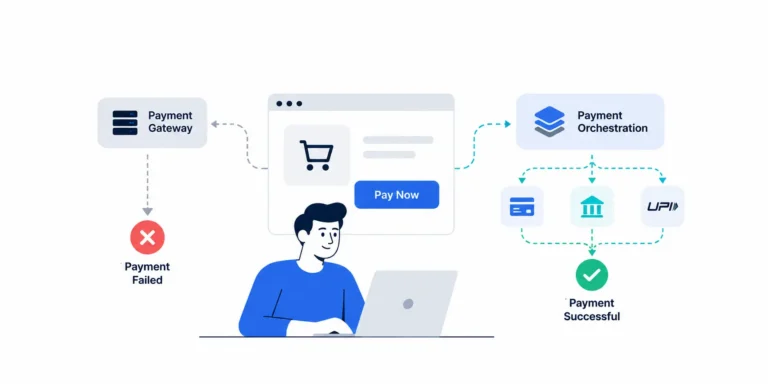
Here’s the important distinction. A smart POS captures the sale at the counter. However, what decides whether that payment succeeds, settles fast, and reconciles cleanly is the orchestration layer beneath it. That’s where FastFlowPe comes in.
FastFlowPe is not a payment gateway, and it isn’t a billing machine. Rather, it’s a payment orchestrator — the intelligence layer that powers modern, omnichannel payment acceptance:
- Accept everything, route intelligently. FastFlowPe connects 15+ PSPs and sends each transaction to the processor with the highest live success rate.
- Fail over automatically. If one provider stumbles, the payment retries on another — reducing failures by 30–50%.
- Settle faster. Through connected banking partnerships, eligible merchants get T+0 settlement, so money collected today lands today.
- Reconcile in one view. Every Collection and Disbursement, online or offline, sits in one dashboard, no manual merging.
- Pay marketplace MDR. Because volume is aggregated across 200+ merchants, you access marketplace rates instead of retail MDR.
In other words, a smart POS modernises the counter; FastFlowPe modernises the money behind it.
A Quick Real-World Picture
Imagine a multi-outlet apparel brand selling both in-store and online. Previously, each channel had its own payment trail, and the finance team spent days every month stitching reports together. With orchestration, however, every rupee, from a smart POS swipe to a website checkout, flows into one reconciled dashboard, while settlements arrive same-day. The brand doesn’t just sell more; it finally sees its business in real time.
Where Smart POS Is Heading
The next wave is invisible and intelligent. Increasingly, POS devices will lean on AI for demand forecasting, fraud scoring, and personalised offers at the counter. Above all, the line between online and offline will disappear, and merchants will expect one unified view of every sale, everywhere. As that omnichannel future arrives, the deciding factor won’t be the device, it will be the orchestration intelligence working behind it.
Conclusion:
The Counter Got Smart — So Should the Money Behind It
A smart POS system replaces the billing machine because business has outgrown single-purpose hardware. Yet the device is only half the upgrade. Ultimately, the brands that win will pair smart acceptance at the counter with smart orchestration beneath it — unified reconciliation, instant settlement, and intelligent routing across every channel.
Want to unify your online and offline payments under one intelligent dashboard? FastFlowPe goes live in 48 hours, one API, one onboarding call.
FAQ Section
1. What is a smart POS system? A smart POS system is a cloud-connected, app-driven device that accepts every payment method (UPI, cards, wallets, QR) on one screen while also tracking inventory, applying offers, and syncing sales data in real time. It’s a business hub, not just a card reader.
2. How is a smart POS different from a traditional billing machine? A billing machine mainly swipes a card and prints a receipt. A smart POS accepts all payment methods, connects to the cloud, unifies data, and integrates with inventory and accounting, replacing several disconnected tools with one.
3. Do small shops in India really need a smart POS? Increasingly, yes. With UPI, cards, and QR all common, customers expect choice, and owners need real-time data. A smart POS removes manual reconciliation and gives even small businesses an omnichannel view.
4. Does FastFlowPe sell smart POS hardware? FastFlowPe is a payment orchestrator, not a hardware vendor. It’s the intelligence layer behind acceptance, routing payments across 15+ PSPs, enabling T+0 settlement, and unifying online and offline reconciliation in one dashboard.
5. How does payment orchestration help a POS setup? Orchestration routes each transaction to the best-performing provider, auto-retries failures, and consolidates every payment into one reconciled view, cutting failed payments by 30–50% and removing manual merging.
6. Can a smart POS and online store share one payment dashboard? Yes. With FastFlowPe, both in-store and online Collections and Disbursements flow into a single dashboard, so finance teams stop stitching channel reports together.
7. How fast can I modernise my payment stack? Go live in 48 hours. One API connects multi PSP routing, connected banking, and unified reconciliation, while FastFlowPe handles the integration and compliance.