
Payment Gateway vs Orchestration: Failed Payments in India
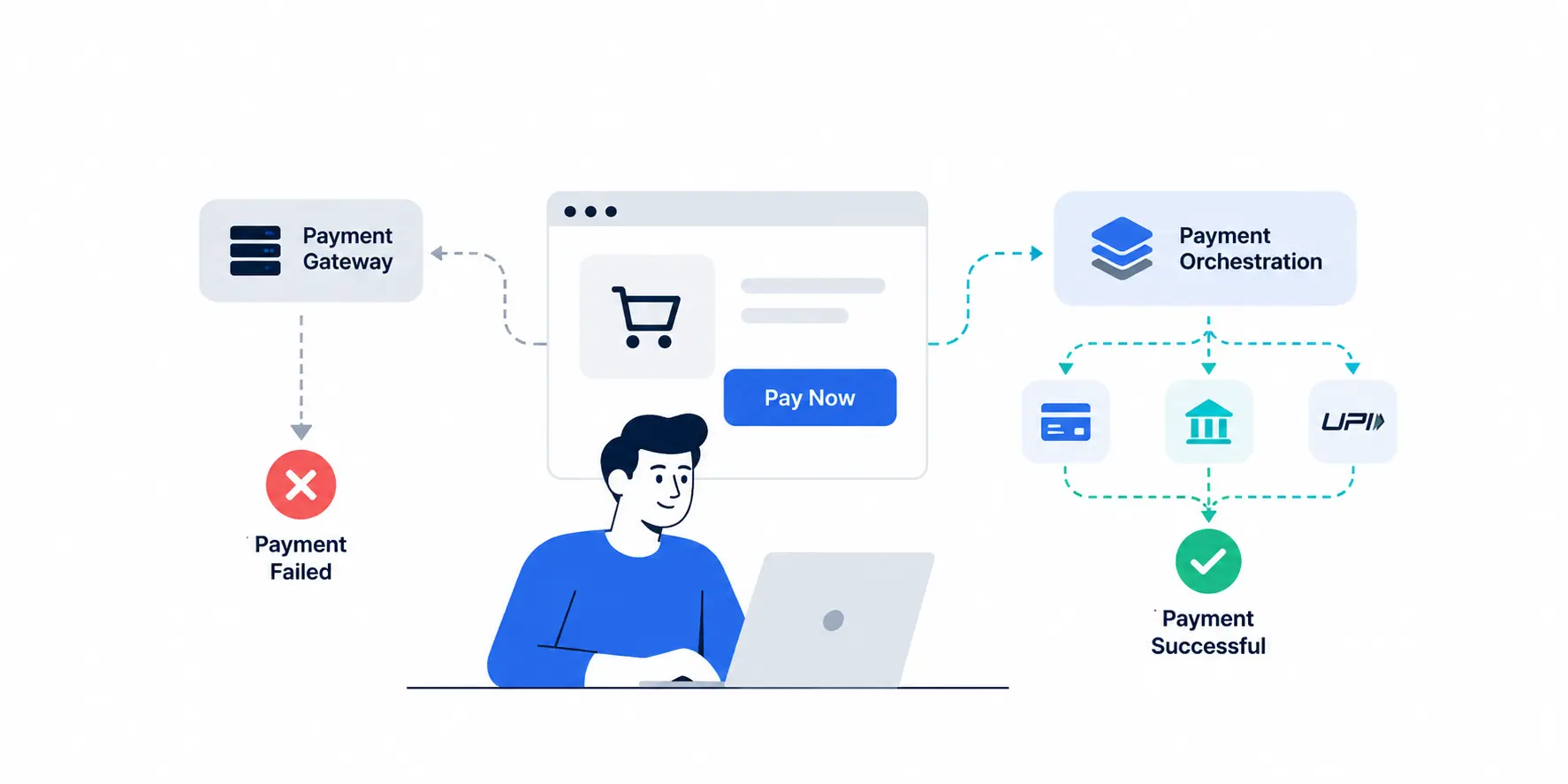
Payment orchestration exists because of a moment every Indian merchant has watched happen in real time: a customer finds the product they want, adds it to the cart, enters their details, selects UPI, and taps Pay — and gets back “Payment failed.” They try again. It fails again. They leave.
To the merchant, this doesn’t look like a technical error — it looks like an abandoned order. But payment failures are rarely as simple as “the gateway was down.” A transaction can fail because of the issuing bank, the PSP, the network, authentication, a timeout, or a temporary technical fault anywhere along the chain between a customer’s tap and a confirmed payment.
Payment orchestration is the infrastructure layer that sits above multiple payment providers and routes transactions between them based on live performance, so a single provider’s bad day doesn’t automatically become the merchant’s lost sale. A payment gateway, by contrast, is a single connection to a single processing path. The difference between the two determines how much a merchant can actually do the moment a payment fails — not just how well they can report on it afterward.
For merchants processing meaningful volume in India’s payment ecosystem, that distinction carries real commercial weight, and it’s one that’s easy to underestimate until a sale-day traffic spike exposes it.
Payment Gateway vs Orchestration: The Core Difference
The clearest way to understand the difference is control over routing.
Payment gateway — one route:
Customer → Merchant → Payment Gateway → PSP/Bank → Payment
If that path hits a problem, the merchant has limited options within that specific transaction. The gateway is doing its job — connecting the merchant to a processor — but it isn’t designed to shop around for a better path when things go wrong.
Payment orchestration — managed routes:
Customer → Merchant → Orchestration Layer → PSP A / PSP B / PSP C → Bank
The orchestration layer applies routing rules, monitors provider performance in real time, and — where the payment method and transaction context allow it — can attempt an alternative route automatically, without the customer needing to do anything differently.
This doesn’t mean every failure becomes recoverable. A decline from insufficient funds, a wrong UPI PIN, or a hard authentication failure can’t be routed around, no matter how many providers sit behind the orchestration layer. What orchestration does do is separate failures that are inherent to the transaction itself from failures that are caused by a specific, avoidable payment path — and that second category is where the recoverable revenue actually lives.
Why Payment Failures Are More Complicated Than They Look
A payment doesn’t travel through one system. It passes through several, and each one is a potential point of failure:
Customer → Merchant → PSP → Acquirer/Network → Issuer Bank
Along that chain:
- The checkout itself can create friction before the payment even starts
- The PSP can hit a technical issue during a traffic spike
- The acquiring side can add latency that times out the session
- The issuing bank can decline the transaction for its own risk reasons
- A network timeout can interrupt the confirmation response
- Authentication (OTP, UPI PIN, 3D Secure) can fail mid-flow for reasons unrelated to the payment itself
Scale is what makes this a structural problem rather than an occasional annoyance. NPCI data reported by PTI shows UPI processed 22.72 billion transactions in June 2026, a slight dip from May’s all-time record but up roughly 24% year-on-year from 18.3 billion transactions in June 2025 — a daily average of 757 million transactions, the highest ever recorded on the network. At that scale, even a failure rate of a fraction of a percent represents millions of individual payment attempts that didn’t complete.
NPCI’s ecosystem statistics also separate business declines (customer-side: insufficient funds, incorrect PIN, exceeded limits) from technical declines (system-side: timeouts, PSP faults, bank-side technical issues). That distinction matters operationally, because the correct response to each is different. You can’t fix a business decline with smarter routing — the transaction was never going to succeed. But a technical decline often can be avoided by routing around whichever part of the chain was unhealthy at that moment.
RBI’s framework on turnaround time and compensation for failed transactions sets auto-reversal timelines for cases where a customer’s account is debited but confirmation never reaches the merchant. It’s a useful reminder that failure handling in India is a regulated, ecosystem-wide concern — not purely a merchant checkout problem to be engineered away.
A Side-by-Side Scenario
Two ecommerce businesses, both selling a ₹7,000 product, both seeing 10,000 payment attempts during the same major sale weekend.
Merchant A — single gateway. Nearly all transactions run through one path: customer, gateway, bank. When that provider degrades for a particular bank or payment method combination — which happens more often during high-traffic events, when every provider on the network is under load — the merchant has no alternative route available within that transaction. The visible result is a cluster of declines, longer response times, more customer retries, more abandoned checkouts, and a spike in support tickets asking “why did my payment fail?”
Merchant B — orchestrated infrastructure. Multiple PSPs sit behind an orchestration layer. If the primary PSP is healthy, transactions flow through it normally. If it starts underperforming and the merchant’s configured routing rules allow it, eligible transactions shift to a secondary PSP automatically — invisibly, from the customer’s side. The customer sees a checkout that works. The infrastructure underneath quietly decided which path gave that transaction the best available chance.
That’s the practical value of orchestration, stated plainly: it turns payment infrastructure from a single route into a managed network of routes, with the decision of “which route” handled by rules instead of by chance.
What Orchestration Can and Can’t Fix
This is the part worth stating without any hedging, because it’s the most commonly overstated claim in payments marketing: orchestration is not a guarantee of payment success.
| Failure type | Can routing help? |
|---|---|
| PSP outage | Often, yes |
| PSP latency during peak load | Often, yes |
| Gateway technical fault | Often, yes |
| Provider-specific degradation for a bank/method combo | Sometimes |
| UPI bank-side technical decline | Depends on the specific failure and whether an alternate route exists |
| Insufficient funds | No |
| Incorrect UPI PIN | No |
| Customer cancels mid-flow | No |
| Authentication failure (OTP/3DS) | Usually not, by routing alone |
| Merchant checkout or configuration error | No |
Orchestration reduces a merchant’s dependency on any single point of failure in the chain. It doesn’t override a customer’s bank balance, and it can’t correct a mistyped PIN. Its real value is resilience and visibility — turning “we don’t know why 4% of payments failed” into “we know exactly which failures were recoverable and which weren’t, and we recovered the ones we could.” That’s a meaningfully different (and more honest) value proposition than “orchestration fixes payment failures.”
Where Recovery Actually Happens
Recovery isn’t one mechanism — it happens at three distinct levels, and merchants who only address one of them tend to leave the other two as blind spots.
1. Prevent the failure before it happens
The first and most valuable objective isn’t recovering a failure — it’s not creating one in the first place. If one PSP consistently outperforms others for a given payment method, bank, or traffic condition, routing logic can send more volume through that path proactively, based on live and historical performance signals, rather than waiting for a failure to react to.
2. Fail over when a provider degrades
During a traffic spike — a flash sale, a festival campaign, a viral moment — if one PSP starts erroring out under load, an orchestration layer can shift eligible transactions to a healthy secondary provider in real time. This is the scenario where a single-gateway merchant has no lever to pull and an orchestrated merchant does.
3. Give the customer another way to pay
Not all recovery happens at the infrastructure level. Sometimes the most effective recovery mechanism is the checkout UX itself: the moment a UPI payment fails, immediately offering another UPI path or a different payment method, so the customer stays inside the purchase journey instead of abandoning it. A failed payment attempt should not automatically become a failed order — that gap is often a UX design problem as much as an infrastructure one.
Why Multiple Gateways Alone Aren’t Orchestration
A common assumption merchants make: “We already run two gateways, so we already have orchestration.”
Not quite. Running Gateway A, Gateway B, and Gateway C side by side is redundancy — each with its own integration, its own dashboard, its own failure logs, its own reconciliation process, with a human deciding manually (or not at all) which one handles which transaction.
Orchestration is a single layer that manages routing, fallback, and performance measurement across that redundancy, so the “which provider handles this transaction” decision isn’t made ad hoc — it’s governed by rules the merchant configures once and refines over time based on real performance data. That’s the operational shift: from reactive, manual provider-juggling to a managed, rules-based system.
The Real Cost of Payment Failures
Payment failures rarely stay contained to the transaction that failed. They tend to ripple across four areas of the business at once:
Revenue. The most direct impact — a customer who can’t complete payment may simply abandon the purchase and not return.
Conversion. Payment completion is the last step of the checkout funnel. A fast, well-designed site can still post a mediocre conversion rate if the payment layer beneath it is unreliable.
Customer trust. Customers don’t distinguish between the merchant, the PSP, the acquirer, the issuing bank, and the network — they see one checkout, and a failure there becomes a brand-level trust problem, not a vendor-attribution problem.
Operations. Every failed payment can generate a support ticket, a refund query, a reconciliation exception, or a manual investigation — turning a payment problem into finance and support workload that scales with transaction volume.
Measuring Failure Recovery Properly
The single aggregate success-rate number on a gateway dashboard can hide exactly the pattern that matters most. It’s worth breaking that number down by:
- PSP
- Payment method
- Issuer bank
- Error code
- Retry attempt number
- Device and geography
And tracking the recovery funnel itself, not just the top-line rate:
Initial attempts → Failed attempts → Eligible recovery attempts → Successful retries → Recovered orders
A merchant might find that overall success looks perfectly acceptable while one specific bank-and-payment-method combination is quietly underperforming — a pattern invisible in an aggregate dashboard and obvious the moment the data is segmented.
A Practical Five-Step Recovery Framework
Step 1 — Identify the failure. Was it customer-side, bank-side, PSP-side, network-side, or checkout-side? The category determines whether recovery is even possible.
Step 2 — Determine whether it’s recoverable. Not every failure should trigger a retry. Repeatedly retrying a transaction that was always going to be declined creates a worse customer experience than a clear, honest failure message.
Step 3 — Select the best available route. Use routing rules based on payment method, live PSP performance, transaction value, and provider availability.
Step 4 — Offer the customer an alternative. Another payment method, another route, a retry, or — when nothing else will work — a clear next step.
Step 5 — Measure the outcome. Track failure → recovery attempt → successful payment as a funnel, not a single number, so the strategy’s actual effectiveness is visible rather than assumed.
Common Mistakes Merchants Make
Treating every failure the same. A bank decline and a PSP outage are different problems with different fixes — collapsing them into one “payment failed” bucket hides the pattern.
Adding gateways without routing logic. More providers don’t automatically create more resilience if nothing is deciding intelligently between them.
Looking only at the overall success rate. Aggregate performance can hide bank-, method-, or provider-level problems that are costing real revenue.
Retrying everything automatically. Some failures shouldn’t be retried — doing so anyway just adds friction and delay to a transaction that was never going to succeed.
Treating failures as purely technical. They touch revenue, conversion, trust, and operations simultaneously — a purely engineering response misses three of the four.
Optimizing checkout UX while ignoring the payment layer. A beautifully designed checkout can’t compensate for an unreliable payment path underneath it.
Merchant Checklist
Infrastructure — Do we rely on one PSP? Can we connect more than one? Do we have a fallback route configured? Can different payment methods route differently?
Failure management — Can we tell bank failures apart from PSP failures? Do we have retry logic, and does it distinguish recoverable from non-recoverable failures? Can we recover eligible failures without adding customer friction?
Visibility — Can we see success rate broken down by PSP and payment method? Can finance and operations see the same data merchants and engineering see?
Scale — What actually happens if our primary PSP goes down mid-sale? How quickly could we switch providers if we had to, today?
If most of these answers are “no,” the business has likely outgrown a single-gateway setup — even if the current setup still technically works most days.
Where This Is Heading
Payment infrastructure in India is moving toward more predictive, less reactive decision-making. A few directions worth watching:
Predictive routing that uses real-time signals rather than only historical performance to choose a payment path before problems surface.
Adaptive checkout that tailors payment method order to customer behavior, device, and geography instead of showing every merchant the same static list.
Smarter recovery logic that distinguishes recoverable from non-recoverable failures automatically, rather than retrying indiscriminately.
Deeper payment intelligence — merchants increasingly need to know not just that a payment failed, but why, and what happened immediately after.
The broader direction is clear: payments are becoming an infrastructure and resilience problem for merchants to manage, not a one-time checkout integration to set up and forget.
The Bottom Line
The question worth asking isn’t “which payment gateway should I use?” It’s “how resilient is my payment infrastructure when one part of it fails?”
A gateway gives a merchant a connection. Orchestration gives them control over a network of connections. That distinction starts to matter once volume grows, multiple PSPs are in play, and one provider’s bad afternoon can affect thousands of customers mid-checkout — not as a hypothetical, but as something that happens during exactly the high-traffic moments when it costs the most.
Vendor note: FastFlowPe is a payment orchestration platform for Indian merchants, offering Smart Routing across connected PSPs (evaluated on live success rate, latency, and uptime) and a unified checkout layer. Claims in this section are FastFlowPe’s own product positioning, not independent data — evaluate them against your own transaction data before deciding. fastflowpe.com
Frequently Asked Questions
A payment gateway connects a merchant to one payment processing path. Payment orchestration sits above multiple providers and manages routing, fallback, and performance across all of them, rather than relying on a single connection.
Not universally. A single gateway can be sufficient for merchants with simple, low-volume payment needs. Orchestration becomes valuable once a business needs multiple PSPs, intelligent routing, and centralized visibility into payment performance.
No. It reduces dependency on any single provider and improves recovery odds for technical failures, but it can’t fix customer-side declines like insufficient funds or an incorrect PIN — no payment infrastructure can guarantee every transaction succeeds.
It depends on the cause. If the failure was provider- or route-related, an alternate path may help. If the failure is due to the customer’s account balance or authentication, changing the PSP won’t change the outcome.
By connecting multiple PSPs and routing transactions based on real-time provider performance, reducing reliance on any single bank or provider path during India’s high-volume UPI traffic, especially during peak sale periods.
Usually not yet. It tends to pay off once volume, payment-method mix, or provider-dependency risk grows large enough that a single PSP’s bad day meaningfully affects revenue — for very low-volume merchants, the operational overhead may outweigh the benefit.
Yes — orchestration manages multiple providers, it doesn’t replace the need for them. How many providers make sense depends on the merchant’s volume, payment-method mix, and risk tolerance.
Start by segmenting existing payment-success data by PSP, payment method, and issuer bank. If that breakdown reveals a consistent pattern of provider- or route-specific failures, that’s the concrete case for adding routing rather than a general one.