
Instant Payouts for Merchants: Why They Matter for Business Impact
You’re sitting in your office on Wednesday morning. You shipped 200 orders yesterday and your customer money arrived but it won’t be in your bank account until next Friday. For most merchants, this is just how payment processing works. A necessary friction. An accepted cost of doing business but what if instant payouts for merchants changed that equation entirely?
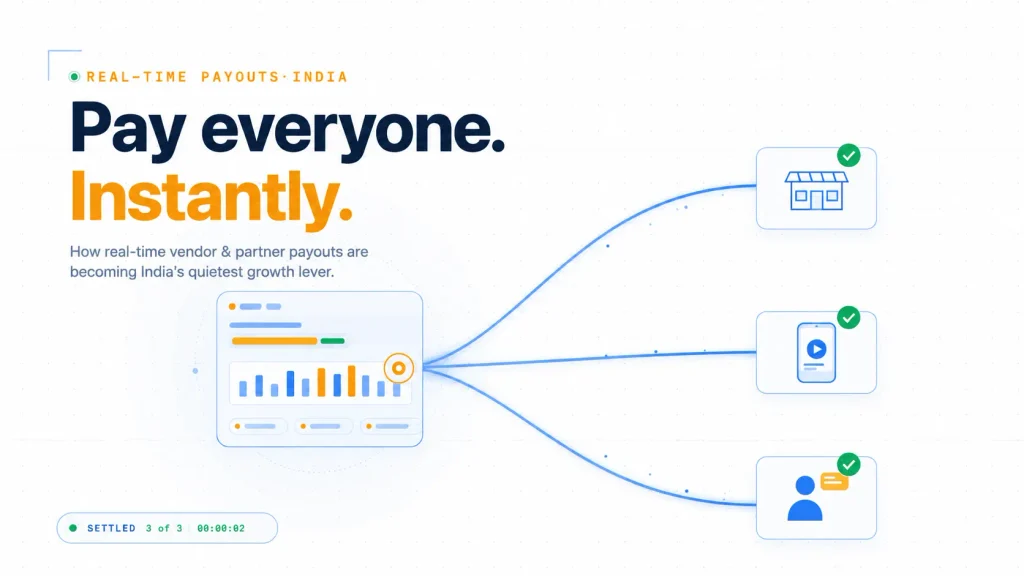
Instant payouts for merchants have quietly become one of the most underrated competitive advantages in digital commerce. While most merchants still wait 2-7 days for funds, a growing segment is accessing customer money the same day—or within hours.
The difference isn’t just about speed. It’s about cash flow, working capital, growth velocity, and business resilience.
For merchants, fintech founders, payment operations teams, and treasury professionals, understanding the real business impact of instant payouts isn’t optional anymore. It’s strategic.
This guide breaks down why instant payouts matter, the quantifiable ROI, and how smart merchants are using faster settlements to outpace competitors.
THE CASH FLOW CRISIS: WHY TIMING MATTERS
Most merchants operate in a perpetual cash flow squeeze, though few recognize the root cause. Here’s the silent killer:
Current state: Payment received Wednesday → Settled Friday → Available Monday = 5-6 day lag
The working capital trap:
- Growth requires capital to purchase inventory, pay staff and fund operations
- Importantly, if you ship first and collect payment later (standard for e-commerce), you’re funding customer purchases from your cash reserves
- Moreover, adding a 5-6 day settlement delay means you’re operating on a knife’s edge
- During seasonal peaks (festivals, sales events), this crisis becomes acute and urgent
According to recent NASSCOM fintech research (2024), 73% of small-to-mid merchants cite cash flow management as their top operational challenge. Significantly, the majority could grow 20-30% faster if settlement delays disappeared entirely.
Instant payouts for merchants directly address this structural problem, eliminating the payment float and freeing trapped capital.
THE PAYMENT INFRASTRUCTURE SHIFT
India’s payment infrastructure is evolving rapidly, driven by regulatory and technological forces. RBI settlement guidelines push toward real-time settlements has enabled a new generation of payment platforms to offer same-day or instant settlement options.
Several key drivers are accelerating this shift:
- NPCI Real-Time Gross Settlement (RTGS) improvements enabling sub-second settlement speeds
- RBI mandate for faster fund movement through Project Sanrakshan modernization
- Private sector innovation creating competitive payout infrastructure across fintech
- API-first payment platforms making instant settlement increasingly accessible as a commodity feature
Notably, major fintech platforms now offer instant payouts for merchants as standard infrastructure, not as premium add-ons. What was premium 2 years ago is table-stakes today.
The competitive advantage clearly goes to merchants who understand this shift first. Those who ignore it fall behind their faster-moving competitors.
CORE PROBLEM: THE COST OF DELAYED SETTLEMENTS
Let’s translate settlement delays into business reality.
Scenario: A ₹5 crore e-commerce business
- Daily payment volume: ₹20 lakh
- Current settlement cycle: 2-day (T+2)
- Average payment float: ₹40 lakh tied up waiting for settlement
Working capital impact:
- ₹40 lakh perpetually locked in payout pipeline
- If short-term funding costs 15% annually: ₹6 lakh/year in implicit interest
- Growth constraint: Can’t spend this capital on inventory or expansion
With instant payouts for merchants:
- Payment float: ₹0-5 lakh (same-day settlement)
- Working capital cost: ₹0 (funds available immediately)
- Capital freed for growth: ₹35-40 lakh
This isn’t theoretical. This is cash flow arithmetic that changes business trajectories.
RESEARCH & DATA: THE NUMBERS THAT MATTER
Market adoption & growth:
- Instant payout market growing 45% YoY in India (RedSeer, 2024)
- 38% of fintech platforms now offer same-day settlement
- Merchants using instant payouts report 2.5x faster cash conversion cycles
Business impact metrics:
- Average working capital improvement: ₹15-50 lakh (for ₹5-20 crore merchants)
- Growth acceleration: 18-25% faster scaling capability
- Inventory turnover improvement: 12-18% (freed capital deployed faster)
- Operational risk reduction: Lower borrowing dependency
Merchant behavior:
- 67% of high-growth merchants prioritize instant settlement (NASSCOM, 2024)
- SaaS/subscription platforms see 22% revenue growth acceleration with instant payouts
- Marketplace platforms reduce vendor churn by 14% when offering instant settlements
Sources: NPCI Settlement Infrastructure Data, RedSeer Consulting, NASSCOM Digital Payments Report 2024, RBI Payment System Study
BUSINESS IMPACT: THE ROI OF INSTANT PAYOUTS FOR MERCHANTS
Real scenario: ₹10 crore subscription SaaS company
Current state (T+2 settlement):
- Monthly revenue: ₹83 lakh
- Settlement wait: 2 days
- Perpetual working capital locked: ₹55 lakh
- Implicit funding cost (15% annual): ₹8.25 lakh/year
With instant payouts for merchants:
- Monthly revenue: ₹83 lakh
- Settlement wait: Same day
- Working capital freed: ₹55 lakh
- Annual savings: ₹8.25 lakh (no funding costs)
- Plus: Freed capital redeployed = 12% faster growth = ₹10 lakh incremental annual revenue
- Customer retention improvement: 8% fewer churn due to healthier business metrics
Total annual impact: ₹18-20 lakh in direct + indirect gains
For a ₹50 crore business? Multiply by 5. The ROI becomes transformational.
THE INSTANT PAYOUTS FRAMEWORK: HOW IT WORKS
1: Customer Payment Initially, the customer completes checkout. Immediately after, the payment hits the merchant acquiring bank.
2: Real-Time Authorization Subsequently, the payment orchestration platform confirms transaction validity through fraud checks and account availability verification.
3:Immediate Settlement Initiation Importantly, unlike traditional T+2 settlement, instant payouts trigger immediate fund transfer to the merchant bank account—within minutes rather than days.
4: Same-Day or Instant Clearing Moreover, using NPCI settlement infrastructure (RTGS/NEFT), funds move within hours or instantly in cutting-edge systems.
5: Merchant Account Credit Finally, funds appear in the merchant bank account same business day and are fully available for immediate withdrawal and deployment.
Why this matters for your business:
- No float = no working capital tied up
- No waiting = immediate business agility
- No financing = reduced debt dependency
- No friction = faster growth
COMPETITIVE ADVANTAGE: WHY INSTANT MATTERS NOW
The merchant landscape is fragmenting. Fast-growing merchants are separating from stagnant competitors. The difference isn’t just product or marketing. It’s infrastructure.
Consider this reality: When 2 merchants have identical products and marketing, but one has instant access to customer payments and one waits 5 days, the faster merchant gains compounding advantages:
- Scales inventory faster (capital available immediately)
- Responds to market trends quicker (agile inventory management)
- Reduces borrowing dependency (healthier balance sheet)
- Invests in growth with own cash (reduced financing costs)
- Survives downturns better (operational resilience)
Beyond these direct benefits, this advantage compounds exponentially. By year 3, the instant-payout merchant has 2-3x the capital mobility of traditional-payout competitors. The competitive moat becomes nearly impossible to close.
Instant payouts for merchants aren’t a feature. They’re a competitive moat.
FUTURE TRENDS: WHERE INSTANT PAYOUTS ARE HEADING
1. Sub-Second Settlement Emerging blockchain and tokenized payment technologies will enable true sub-second settlement—significantly faster than traditional clearing infrastructure allows today.
2. Predictive Cash Flow Management Additionally, AI-powered systems will predict optimal payout timing based on merchant cash flow patterns, effectively automating working capital optimization across all business types.
3. Embedded Finance Integration Furthermore, merchants won’t need separate payout accounts in the future. Instead, payouts will embed directly into merchant operating systems, creating seamless financial workflows.
4. Multi-Currency Instant Payouts Moreover, cross-border merchants will soon access instant settlements in multiple currencies—finally eliminating forex timing arbitrage and settlement delays.
5. Conditional Payouts Eventually, smart contracts will enable payouts triggered by real-time business events (inventory thresholds, revenue targets, seasonal patterns), creating truly intelligent payment systems.
FAQ 1: What exactly are instant payouts for merchants?
Instant payouts for merchants means your customer payments settle into your bank account the same business day (or faster), instead of waiting 2-7 days. Using real-time clearing infrastructure, funds are transferred immediately after customer payment, giving merchants immediate access to cash.
Key difference: Traditional payouts (wait 2-7 days) vs. Instant payouts (same day or within hours).
FAQ2: How do instant payouts for merchants improve cash flow?
Instant payouts eliminate the “payment float”—the money stuck in the settlement pipeline. For a ₹5 crore business, this typically frees ₹30-50 lakh in working capital immediately. Instead of waiting 5 days to access customer payments, you get them same day. This capital can be redeployed for inventory, operations, or growth—improving cash conversion cycles by 25-30%.
FAQ 3: What’s the cost of instant payouts for merchants?
Pricing varies. Premium payment platforms charge 0.5-1.5% on instant payout volume (vs. 0.1-0.3% for standard 2-day payouts). For many merchants, the ROI of freed working capital far exceeds these fees. Example: ₹5 crore business might pay ₹7.5 lakh/year in extra fees but save ₹6 lakh/year in financing costs—net positive ROI.
Always compare total cost vs. working capital benefit.
FAQ 4: Which merchants benefit most from instant payouts?
Instant payouts benefit:
- SaaS/subscription platforms (recurring billing, predictable cash flow)
- High-growth e-commerce (inventory-heavy, capital-constrained)
- Marketplaces (vendor retention improves with faster payouts)
- Edtech (seasonal revenue spikes, liquidity crunches)
- B2B fintech (working capital critical for operations)
- Seasonal businesses (festival/peak season capital needs)
Essentially: Any business where working capital is a growth constraint.
FAQ 5: Are instant payouts for merchants available in India?
Yes, increasingly. Multiple payment platforms now offer same-day or next-day settlement. RBI’s push toward faster settlements has enabled this. However, availability varies by platform, merchant type, and settlement bank. Premium or high-volume merchants get priority access. Check with your payment gateway about instant payout options.
FAQ 6: How do instant payouts for merchants differ from traditional settlement?
Traditional: Payment received → Processing (24 hrs) → Clearing (24 hrs) → Settlement window (next business day) → Merchant receives funds (T+2 or T+3) receives funds (T+2 or T+3)
Instant payouts: Payment received → Immediate authorization → Same-day fund transfer → Merchant receives funds (same business day)
The difference: ~48-72 hours of float eliminated. For capital-constrained businesses, this is transformational.
FAQ 7: What are the risks of instant payouts for merchants?
Minimal operational risk (settlement infrastructure is secure). Main considerations:
- Fee cost: Higher than standard payouts (weigh vs. working capital benefit)
- Fraud exposure: Merchants assume chargeback/refund liability faster (instead of float protection)
- Liquidity management: Instant availability means discipline required (easy to over-deploy capital)
Most risks are manageable with proper treasury practices.
FAQ 8: How do instant payouts impact merchant growth?
Significantly. Freed working capital accelerates growth: faster inventory replenishment, quick response to market trends, reduced borrowing dependency. Studies show merchants with instant payouts grow 18-25% faster than those with traditional settlement. For SaaS platforms, instant payouts improve vendor retention by 12-14%. The effect is cumulative—faster scaling over 3-5 years creates 2-3x business value difference.
CONCLUSION: INSTANT PAYOUTS ARE INFRASTRUCTURE, NOT LUXURY
Instant payouts for merchants have crossed the adoption threshold. They’re no longer premium—they’re becoming baseline infrastructure.
The merchants who understand this now are building competitive advantages that will compound for years. Those who wait until it’s standard are ceding growth opportunity to faster competitors.
Working capital is the oxygen of business growth. When you remove artificial settlement delays, you free capital, when you free capital, you grow faster and when you grow faster, you win market share.
The question isn’t whether to adopt instant payouts. It’s when.
Your next strategic move? Calculate your current payment float. Quantify the working capital cost. Compare against instant payout fees. Then make the decision.
For capital-constrained high-growth businesses, instant payouts aren’t an option—they’re essential infrastructure.
That’s the competitive advantage Fastflowpe delivers.